
Inverse Differentiation and Derivative Calculation
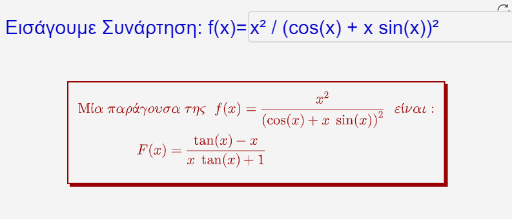
Loading the math board and drawing, please wait…
This example demonstrates how to calculate the derivative of a function through inverse differentiation. Key math concepts include integral calculus, means, statistics, coordinates, exponential functions, and stochastic or random processes. It utilizes GeoGebra commands like Integral, Textfield, Line, Vector, Stretch, Shear, Sequence, AffineRatio, and ConvexHull for construction. Suitable for high school and above, focusing on understanding the relationship between integrals and derivatives, and function graphing techniques.
GeoGebra Commands & Parameters
Integral(f) → FTextfield(f) → Εισ1Line(G, B) → aLine(D, H) → bLine(C, E) → cLine(A, E) → dLine(G, C) → eVector(z, z_1) → uVector(w, z_1) → vStretch(f, v) → f_1Stretch(f, u) → f_2Stretch(F, v) → F_1Stretch(F, v) → F_2Shear(f, a, 0.6666666666666666) → f_3Shear(F, c, 1.5) → F_3Shear(f, b, 0.8333333333333334) → f_4Sequence(log(k^(4) + 1), k, 1, 90) → λίστα1Sequence(F(k), k, 1, 90) → λίστα2Sequence(f(k^(2)), k, 1, 90) → λίστα3AffineRatio(A, B, C) → gConvexHull({C, D, E, G}) → γτ1