
Introduction to Translation of Shapes
Loading the math board and drawing, please wait…
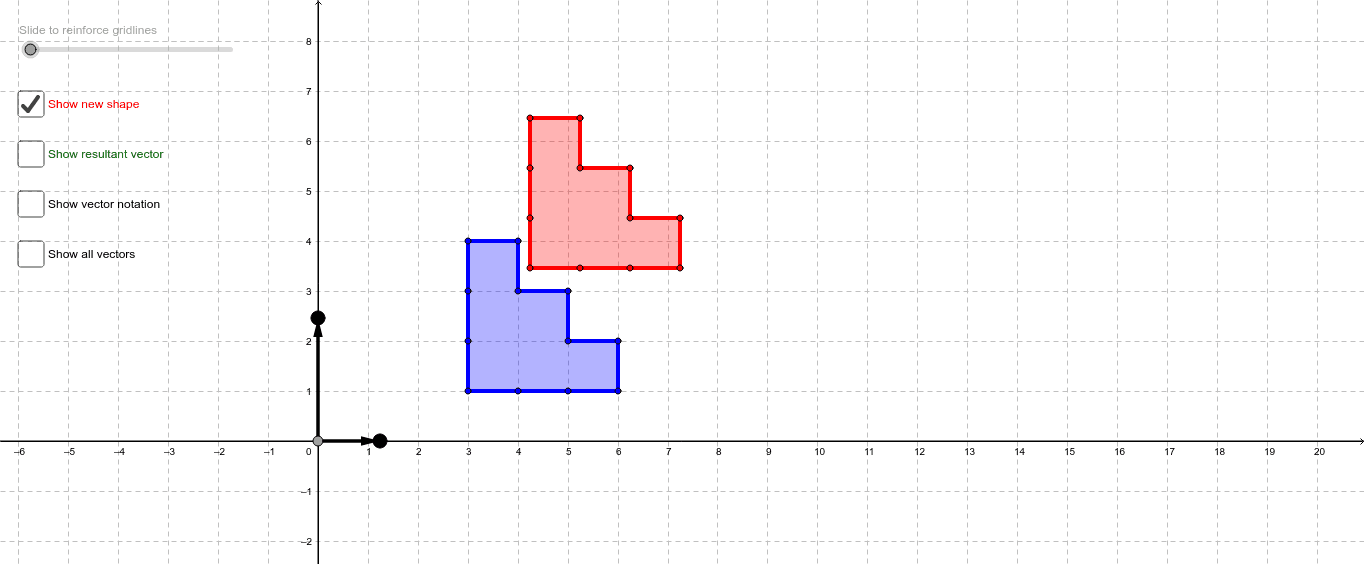
This example demonstrates creating an identical shape to the blue one by using horizontal and vertical arrows to perform a translation. Key math concepts include geometric transformations, vectors in coordinate planes, and the properties of translations. It uses commands like Intersect, Point, Vector, Polygon, and Translate to construct the shapes and apply the transformation. Suitable for middle school and high school students learning about 2D geometric transformations and introductory coordinate geometry.
GeoGebra Commands & Parameters
Intersect(xAxis, yAxis) → APoint(b) → BPoint(a) → CVector(A, B) → uVector(A, C) → vPolygon(D, E, N, O, F, G, H, I, J, K, L, M) → poly1, d, m, n, o, e, f_1, g_1, h, i, j, k_1, lTranslate(D, w) → D'Translate(E, w) → E'Translate(F, w) → F'Translate(G, w) → G'Translate(H, w) → H'Translate(I, w) → I'Translate(J, w) → J'Translate(K, w) → K'Translate(L, w) → L'Translate(M, w) → M'Translate(N, w) → N'Translate(O, w) → O'Polygon(D', E', N', O', F', G', H', I', J', K', L', M') → poly1', d', m', n', o', e', f', g', h', i', j', k', l'Translate(D, w) → D'_1Vector(D, D'_1) → cTranslate(E, w) → E'_1Vector(E, E'_1) → pTranslate(F, w) → F'_1Vector(F, F'_1) → qTranslate(G, w) → G'_1Vector(G, G'_1) → rTranslate(H, w) → H'_1Vector(H, H'_1) → sTranslate(I, w) → I'_1Vector(I, I'_1) → tTranslate(J, w) → J'_1Vector(J, J'_1) → u_1Translate(K, w) → K'_1Vector(K, K'_1) → v_1Translate(L, w) → L'_1Vector(L, L'_1) → w_1Translate(M, w) → M'_1Vector(M, M'_1) → a_1Translate(N, w) → N'_1Vector(N, N'_1) → b_1Translate(O, w) → O'_1Vector(O, O'_1) → c_1
AI Drawing Prompt Reference
Draw a blue polygon and demonstrate its translation using horizontal and vertical arrows to create an identical new polygon. Start by marking the intersection point of the coordinate axes, then draw two vectors representing horizontal and vertical directions. Next, use these vectors to translate each vertex of the polygon to a new position, forming a translated polygon. Finally, draw the vectors showing the translation process and label the corresponding relationship between the original and translated polygons.
The prompt above was compiled from the original drawing commands and is for reference only.