
Introduction to Dilations by David Taube
Loading the math board and drawing, please wait…
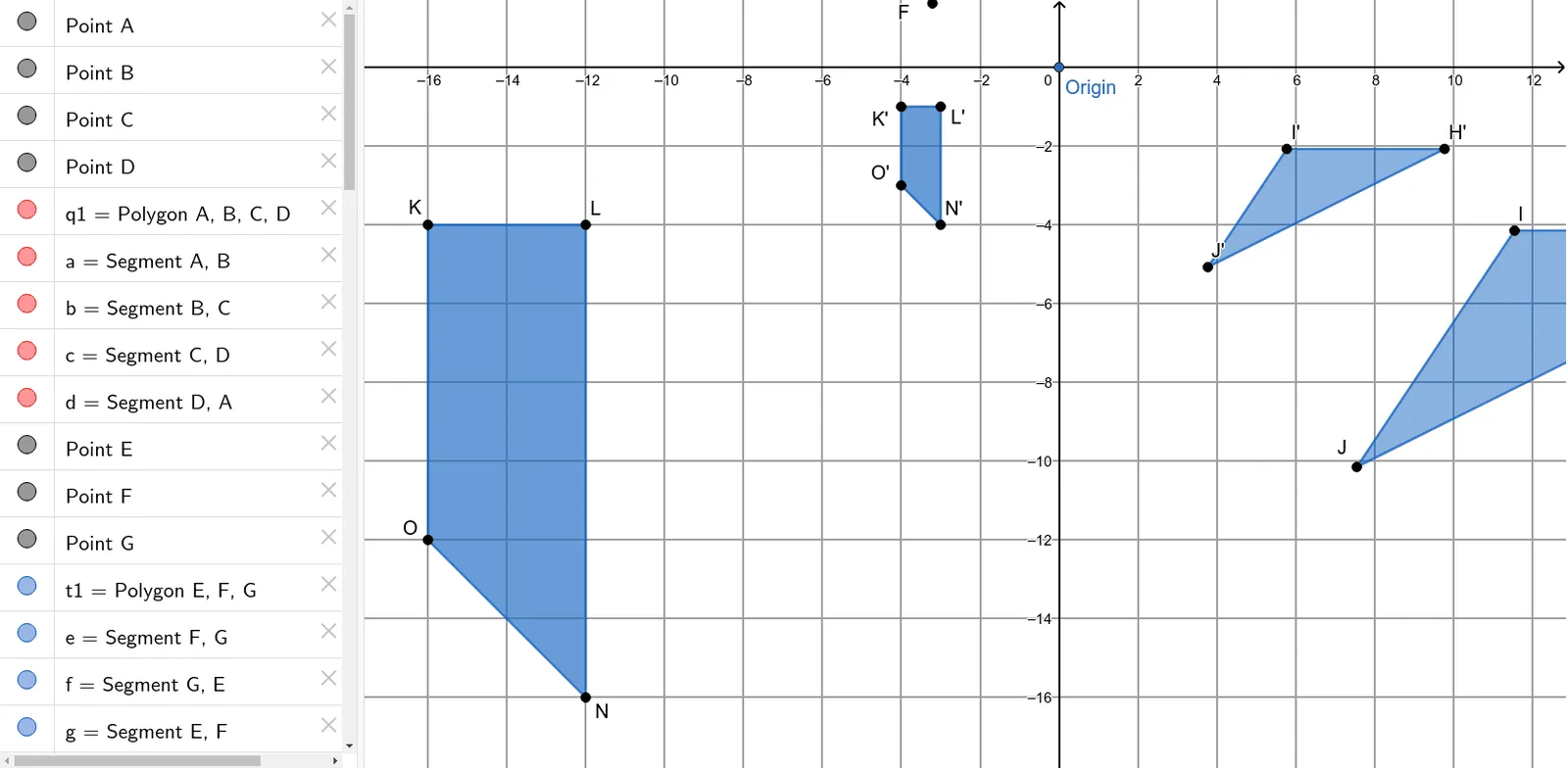
This example demonstrates the concept of dilations. It involves key mathematical concepts such as dilations, polygons, and vectors. Using GeoGebra commands like Polygon and Dilate, the construction of dilation effects is shown. Suitable for students at the middle school level and above to learn the basic principles of dilations.
GeoGebra Commands & Parameters
Polygon(A, B, C, D) → q1, a, b, c, dPolygon(E, F, G) → t1, g, e, fPolygon(H, I, J) → t2, j, h, iPolygon(K, O, N, L) → q2, k, o, n, lPoint(yAxis) → MPoint(xAxis) → OriginDilate(A, 4, Origin) → A'Dilate(B, 4, Origin) → B'Dilate(C, 4, Origin) → C'Dilate(D, 4, Origin) → D'Polygon(A', B', C', D') → q1', a', b', c', d'Dilate(E, 2, Origin) → E'Dilate(F, 2, Origin) → F'Dilate(G, 2, Origin) → G'Polygon(E', F', G') → t1', g', e', f'Dilate(H, 0.5, Origin) → H'Dilate(I, 0.5, Origin) → I'Dilate(J, 0.5, Origin) → J'Polygon(H', I', J') → t2', j', h', i'Dilate(K, 0.25, Origin) → K'Dilate(O, 0.25, Origin) → O'Dilate(N, 0.25, Origin) → N'Dilate(L, 0.25, Origin) → L'Polygon(K', O', N', L') → q2', k', o', n', l'
AI Drawing Prompt Reference
On a coordinate plane, draw several polygons centered around the origin. Start with a quadrilateral, then two triangles, and another quadrilateral at different positions. Using the origin as the center, enlarge the first quadrilateral by a factor of 4, the second triangle by 2, shrink the third triangle to half size, and reduce the last quadrilateral to a quarter. Each scaled copy keeps its shape, with vertices moving along lines from the origin, resulting in a set of similar polygons of varying sizes to illustrate dilation.
The prompt above was compiled from the original drawing commands and is for reference only.