
How many degrees is that rotation? Rotation angle discovery
Loading the math board and drawing, please wait…
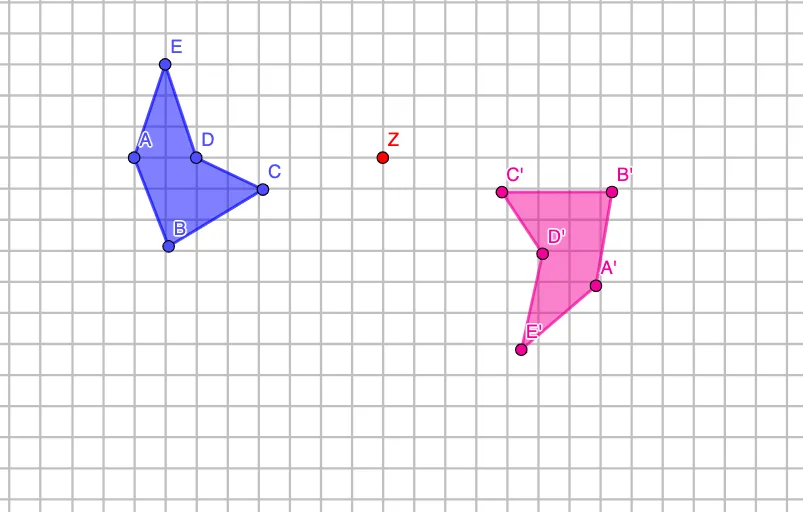
This example demonstrates how to determine the rotation angle in a geometric setting by constructing an original polygon and its rotated copy, then using the correspondence between matched vertices and the resulting overlap to read or infer the rotation in degrees. The key mathematics includes geometric transformations (rotation and translation), invariants under rigid motion, and angle determination from constructed relationships between corresponding points. In GeoGebra, it is built with commands such as Translate, Rotate, and Polygon to create the initial objects (points like A, B, C, D, E and polygon poly1) and then generate rotated counterparts (A', B', C', D', E' and polygon poly1') by rotating around the appropriate center/direction elements (e.g., objects like u and other defining points/parameters). The workflow emphasizes constructing translated/rotated polygons and then extracting the rotation angle from the geometry of corresponding segments and angles. Suitable for middle and high school geometry lessons, practice on angle measurement, and transformation-based reasoning.
GeoGebra Commands & Parameters
Translate(F_{1}, u) → D_{1}Translate(E_{1}, u) → E'_{2}Rotate(A_{1}, 120°, Z) → A'_{2}Rotate(B_{1}, 120°, Z) → B'_{2}Rotate(C_{1}, 120°, Z) → C'_{2}Rotate(F, 120°, Z) → F'Rotate(G, 120°, Z) → G'Rotate(A_{1}, 120°, Z) → HRotate(B_{1}, 120°, Z) → IRotate(C_{1}, 120°, Z) → JRotate(F, 120°, Z) → F'_{1}Rotate(G, 120°, Z) → G'_{1}Polygon(A, B, C, D, E) → poly1, a, b, c, d, eRotate(A, 149°, Z) → A'Rotate(B, 149°, Z) → B'Rotate(C, 149°, Z) → C'Rotate(D, 149°, Z) → D'Rotate(E, 149°, Z) → E'Polygon(A', B', C', D', E') → poly1', a', b', c', d', e'
AI Drawing Prompt Reference
Draw a pentagon and rotate it about one of its vertices by approximately 149 degrees to create a second pentagon. Additionally, take another set of points, translate them along a direction, then rotate them by 120 degrees about the same center, producing a third set of rotated points. Show the original pentagon, the rotated pentagon, and the translated-then-rotated points clearly, with corresponding vertices connected or overlapping to reveal the rotation angle. The composition should emphasize the geometric transformation relationships for angle measurement.
The prompt above was compiled from the original drawing commands and is for reference only.