
Hexagonal Flower with Semicircles
Loading the math board and drawing, please wait…
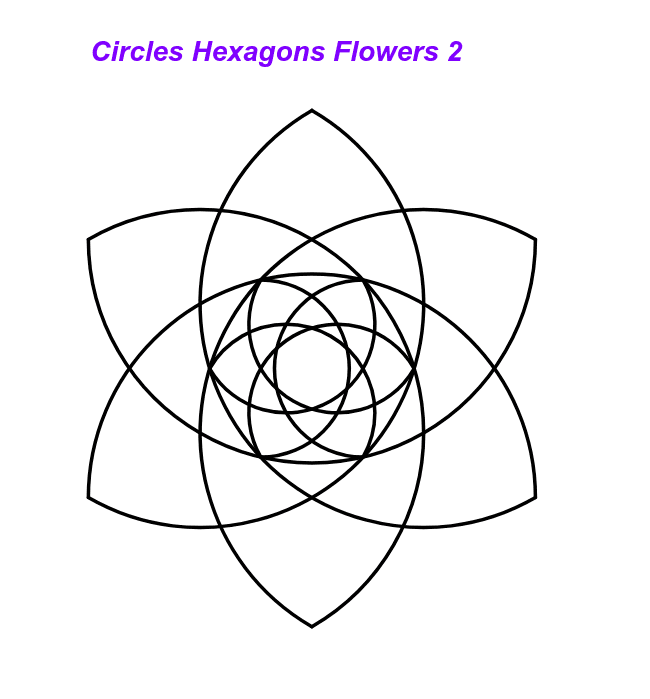
This example demonstrates a flower pattern composed of 6 semicircles. It involves concepts of symmetry and transformation. GeoGebra commands used include Sequence, Point, Semicircle, and Intersect. Suitable for middle school and above students to learn about symmetry and transformations.
GeoGebra Commands & Parameters
Sequence(Rotate[A, (i * π / 3)], i, 1, 5) → list1Point(list1) → BSemicircle(A, B) → cPoint(list1) → CPoint(yAxis) → DSemicircle(C, D) → dPoint(list1) → ESemicircle(B, E) → ePoint(list1) → FSemicircle(D, F) → fSemicircle(E, A) → gSemicircle(F, C) → hIntersect(d, e, 1) → GSequence(Rotate[G, (i * π / 3)], i, 1, 5) → list2Intersect(f, g, 1) → HSemicircle(G, H) → kIntersect(e, f, 1) → IPoint(list2) → JSemicircle(I, J) → pIntersect(c, h, 1) → KSemicircle(H, K) → qIntersect(c, d, 1) → LSemicircle(J, L) → rSemicircle(K, G) → sSemicircle(L, I) → t
AI Drawing Prompt Reference
Draw a hexagonal flower pattern made up of 6 semicircles. Start by rotating a point A 5 times by 60 degrees to get 6 new points B, C, D, E, and F. Then, draw 6 semicircles using these points as endpoints to form a hexagonal outline. Next, find the intersection of semicircles d and e, then rotate this intersection point 5 times to get new intersection points and draw new semicircles. Repeat this process to create a hexagonal flower pattern with 12 semicircles.
The prompt above was compiled from the original drawing commands and is for reference only.