
Gravitational Field of a Spherical Shell
Loading the math board and drawing, please wait…
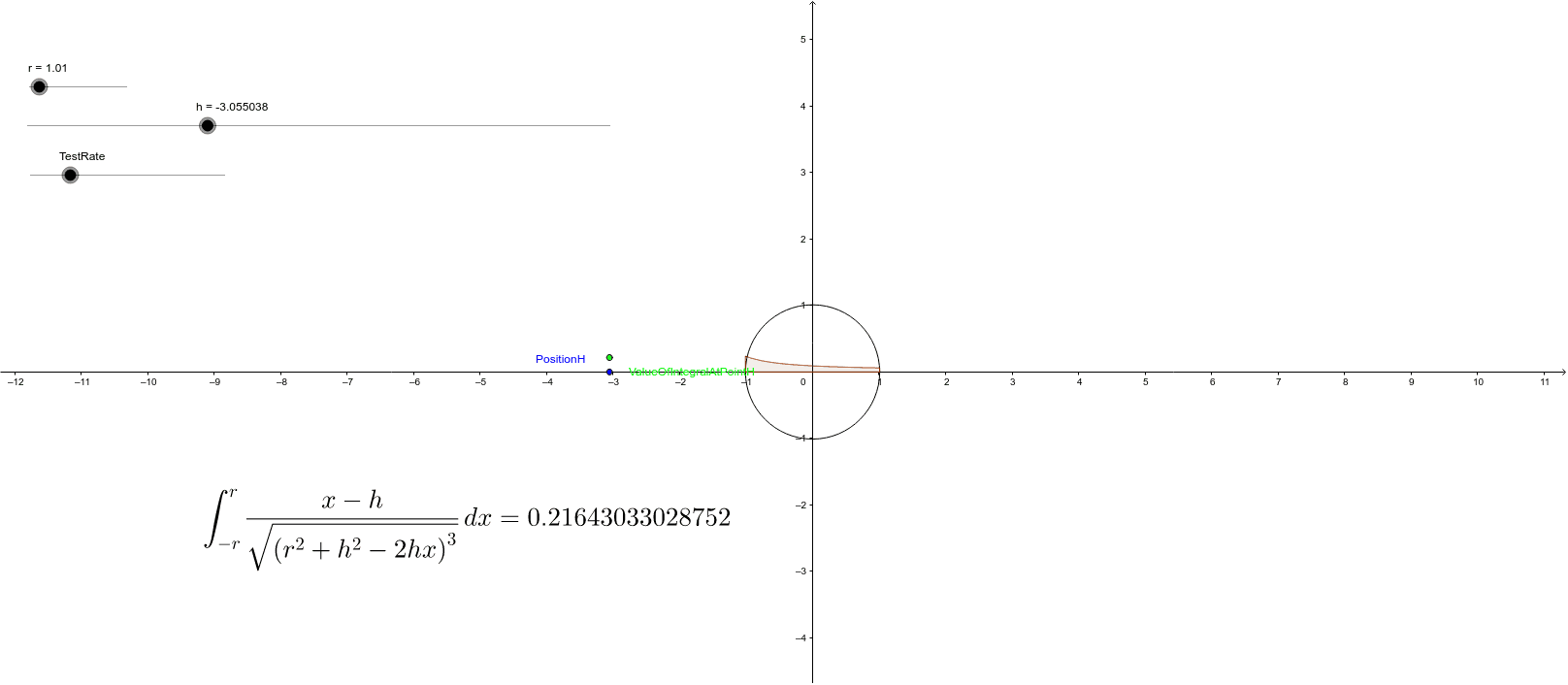
This example demonstrates the variation in gravitational acceleration caused by an infinitely thin spherical shell at a point h units away from its center. It involves core mathematical concepts like integral calculus, vector analysis, and physical laws in spherical coordinates. GeoGebra commands such as Intersect, Circle, Segment, and Integral are used to construct the model, with sliders for parameters like h, a, and r to visualize the field. Suitable for high school students and university-level learners in physics and mathematics for understanding gravitational theory and numerical simulation.
GeoGebra Commands & Parameters
Intersect(xAxis, yAxis) → ACircle(A, B) → cSegment(PositionH, C) → bIntegral((x - h) / (r^(2) + h^(2) - ((2 * h) * x))^(1.5), (-r), r) → eIntegral((r^(2) + h^(2) - ((2 * h) * x))^(1.5), (-r), r) → i
AI Drawing Prompt Reference
Draw the gravitational field variation of an infinitely thin spherical shell at a point h units away from its center. First, draw the intersection point A of the x-axis and y-axis. Then, draw a circle c with A and B as its center. Next, draw a line segment b from A to a point C on the circle. Finally, calculate and draw the integrals e and i representing the gravitational acceleration and field from a point on the circle to A.
The prompt above was compiled from the original drawing commands and is for reference only.