
Graphing Trigonometric Functions
Loading the math board and drawing, please wait…
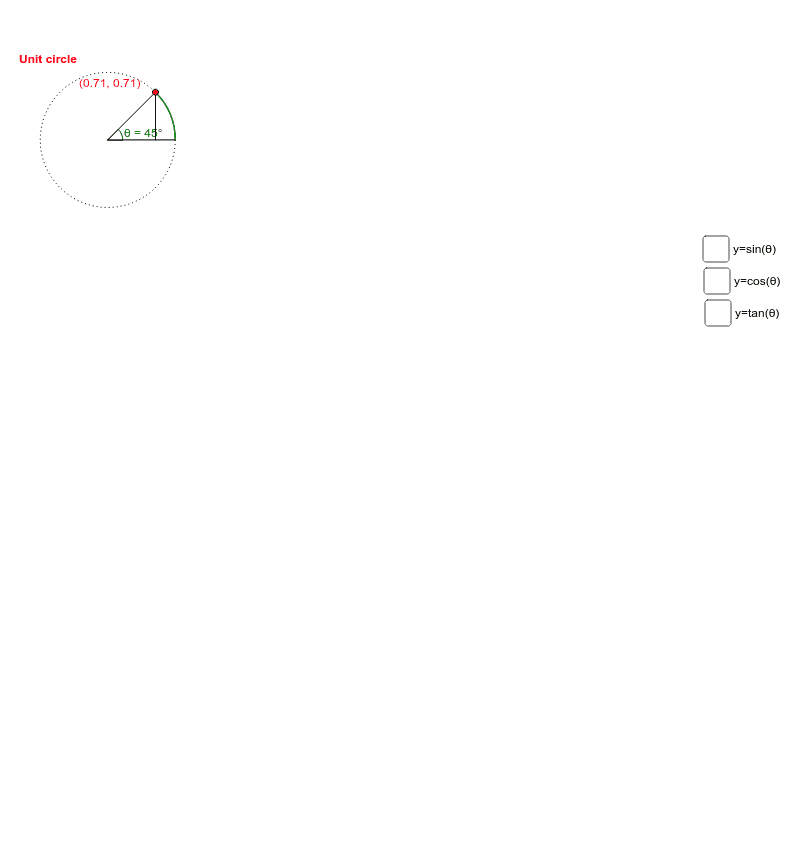
This example demonstrates how to graph trigonometric functions using GeoGebra. It involves core math concepts like trigonometric functions, function graphs, and analytical geometry. Key GeoGebra commands and objects used include Intersect, Point, Circle, Segment, Angle, OrthogonalLine, CircleArc, Function, Line, Polygon, and Mirror. It is suitable for high school students learning to plot trigonometric function graphs and understand their geometric properties and transformations.
GeoGebra Commands & Parameters
Intersect(xAxis, yAxis) → APoint(xAxis) → BCircle(A, B) → cPoint(c) → CSegment(A, C) → bAngle(B, A, C) → θIntersect(c, xAxis, 2) → ESegment(E, B) → aOrthogonalLine(C, a) → dIntersect(d, a) → DSegment(A, D) → eSegment(C, D) → fPoint(xAxis) → FPoint(xAxis) → GSegment(F, G) → gSegment(H, I) → hCircleArc(A, B, C) → kOrthogonalLine(P, g) → iIntersect(g, i) → JSegment(P, J) → jSegment(F, J) → lFunction(sin(x - 2), 2, 8.3) → f_1Intersect(f_1, g, (5.14159265360225, -1.2456579871614342E-11)) → KIntersect(f_1, g, (8.283185307179632, 4.594034846457704E-14)) → LSegment(C, P) → mPoint(h) → MPoint(h) → NPoint(yAxis) → OPoint(yAxis) → QSegment(O, Q) → nSegment(R, S) → pOrthogonalLine(T, n) → qIntersect(q, n) → USegment(T, U) → rSegment(U, O) → sSegment(D, T) → tPoint(n) → VPoint(n) → WPoint(n) → YPoint(n) → ZPoint(p) → A_1Point(p) → B_1Segment(C_1, D_1) → a_1Segment(E_1, F_1) → b_1Point(g) → G_1Point(g) → H_1OrthogonalLine(G_1, b_1) → c_1OrthogonalLine(H_1, b_1) → d_1Intersect(b_1, c_1) → I_1Intersect(b_1, d_1) → J_1Point(c_1) → K_1Point(d_1) → L_1Segment(K_1, I_1) → e_1Segment(J_1, L_1) → g_1Point(b_1) → M_1Point(b_1) → N_1Point(b_1) → O_1Point(b_1) → P_1Point(b_1) → Q_1Point(b_1) → R_1Point(a_1) → S_1Point(a_1) → T_1Segment(I_1, U_1) → h_1Segment(W_1, J_1) → i_1OrthogonalLine(V_1, b_1) → j_1Intersect(j_1, b_1) → Y_1Segment(E_1, Y_1) → k_1Segment(A, Z_1) → l_1OrthogonalLine(Z_1, l_1) → m_1Line(A, C) → n_1Intersect(m_1, n_1) → A_2Segment(Z_1, A_2) → p_1Segment(Z_1, A_2) → q_1Segment(A, A_2) → r_1Segment(A_2, V_1) → s_1Segment(V_1, Y_1) → t_1Segment(A, B_2) → a_2Segment(C, D) → b_2Polygon(N, C_2, D_2, M) → poly1, n_2, c_2, d_2, m_2Intersect(g, h) → G_2Intersect(h, m_2) → H_2Polygon(B_1, I_2, J_2, A_1) → poly2, b_3, i_2, j_2, a_3Point(a_1) → L_2Point(a_1) → M_2Mirror(I_1, a_1) → N_2Segment(O_2, P_2) → e_2Polygon(O_2, K_1, U_1, P_2) → poly3, o_2, k_2, u_1, p_2