
Geometric Justification for Law of Cosines
Loading the math board and drawing, please wait…
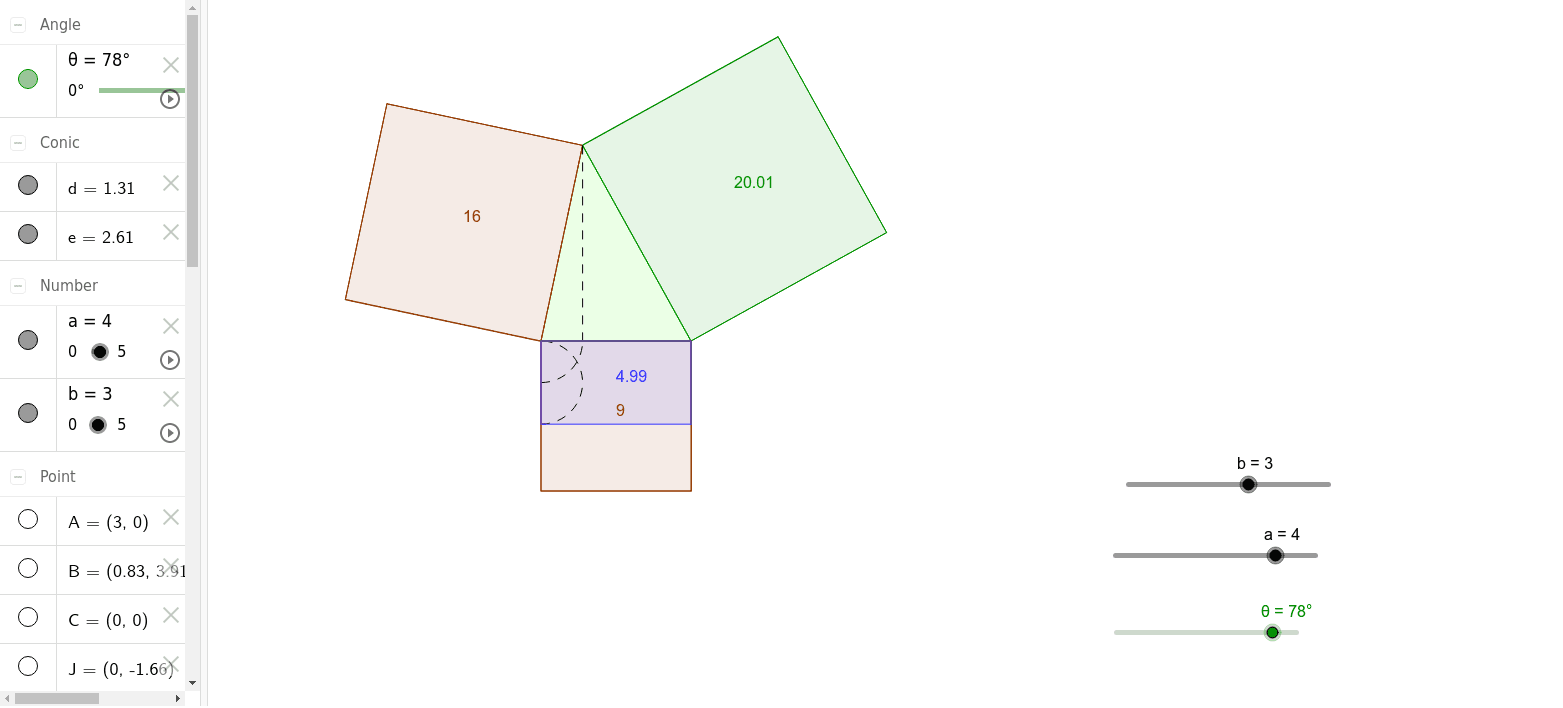
This example dynamically demonstrates the relationship between the sides and the included angle of a triangle, visually illustrating the geometric principle of the Law of Cosines. Core mathematical concepts include the Law of Cosines, triangle geometry, and vector projection. Construction highlights involve GeoGebra commands like Polygon, Segment, and CircleArc to build the triangle and auxiliary shapes, defining objects such as angle θ, side lengths a, b, and vertices B, A, C. Suitable for high school mathematics students and teachers to understand the derivation and geometric meaning of the Law of Cosines.
GeoGebra Commands & Parameters
Polygon(A, B, C) → poly1, c, a_1, b_1Polygon(B, A, 4) → poly2, f, g, h, i, D, EPolygon(C, B, 4) → poly3, j, k, l, m, F, GPolygon(A, C, 4) → poly4, n, p, q, r, H, ISegment(B, L) → sPolygon(C, J, K, A) → poly5, c_1, j_1, k_1, a_2CircleArc(C, M, L) → dCircleArc(M, J, C) → e
AI Drawing Prompt Reference
Draw a triangle and dynamically demonstrate the relationship between its sides and included angle to illustrate the Law of Cosines geometrically. Start by constructing triangle ABC, then draw three semicircles with diameters AB, BC, and CA. Connect the centers of the circles to the triangle's vertices and label key points and segments. Finally, use auxiliary shapes and vector projections to visually show the derivation of the Law of Cosines.
The prompt above was compiled from the original drawing commands and is for reference only.