
Geometric Derivation of the Sine of a Sum
Loading the math board and drawing, please wait…
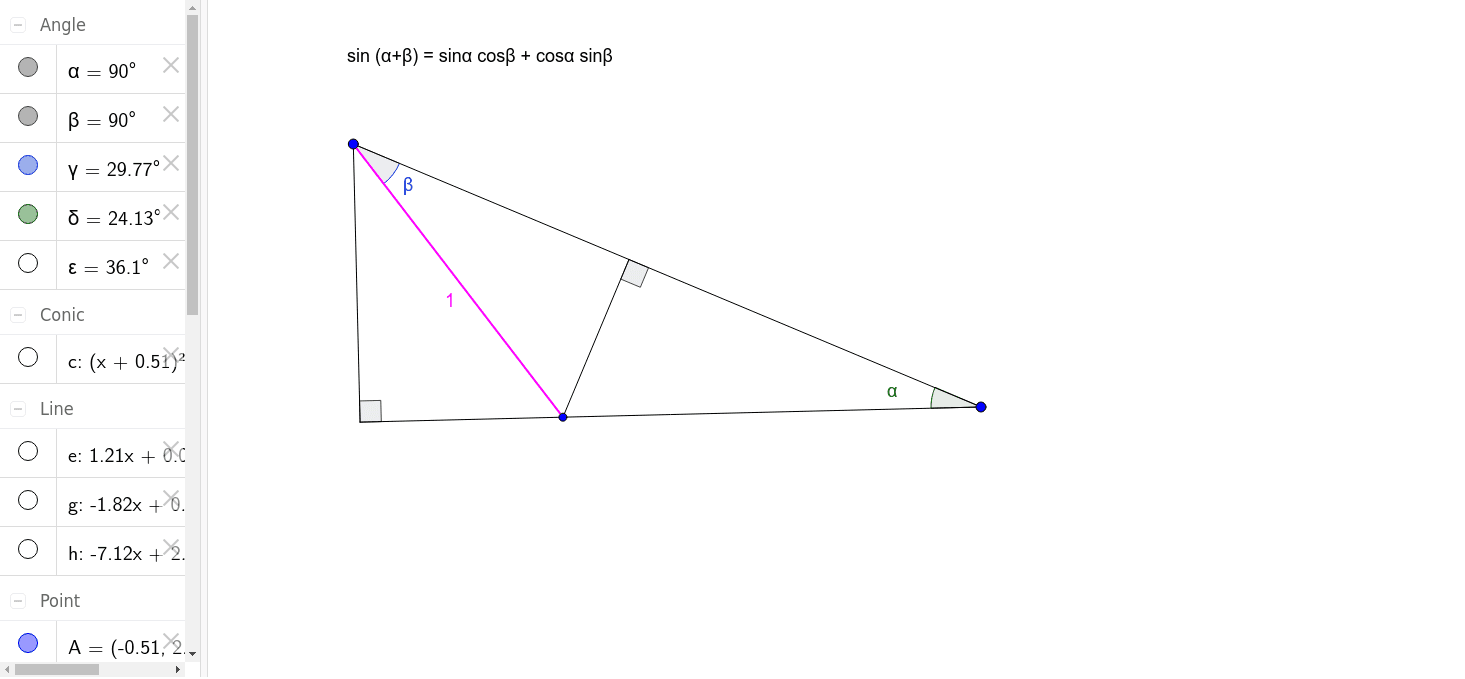
① This example demonstrates the geometric derivation of the sine addition formula sin(α+β) using a carefully constructed figure, allowing learners to visualize the origin of this trigonometric identity. ② The core mathematical concept is the sine addition formula, involving the definitions of sine and cosine in right triangles and the geometric meaning of adding angles. ③ Construction highlights: based on the construction summary, it uses GeoGebra commands such as Circle, Point, Segment, Ray, OrthogonalLine, Intersect, and Angle, creating multiple triangles and auxiliary lines, with angles labeled α, β, γ, δ, ε to show relationships. ④ Suitable for high school or early college trigonometry instruction, and for teachers creating dynamic demonstrations to help students grasp the geometric essence of the formula.
GeoGebra Commands & Parameters
Circle(A, 1) → cPoint(c) → BSegment(A, B) → aSegment(A, B) → bRay(C, B) → dOrthogonalLine(A, d) → eSegment(A, C) → fOrthogonalLine(B, f) → gIntersect(g, f) → DOrthogonalLine(D, f) → hIntersect(e, d) → ESegment(A, E) → iSegment(E, C) → jSegment(D, B) → kAngle(B, D, C) → αAngle(B, E, A) → βAngle(B, A, D) → γAngle(D, C, B) → δAngle(E, A, B) → ε