
Geometric Derivation of the Sine of a Difference
Loading the math board and drawing, please wait…
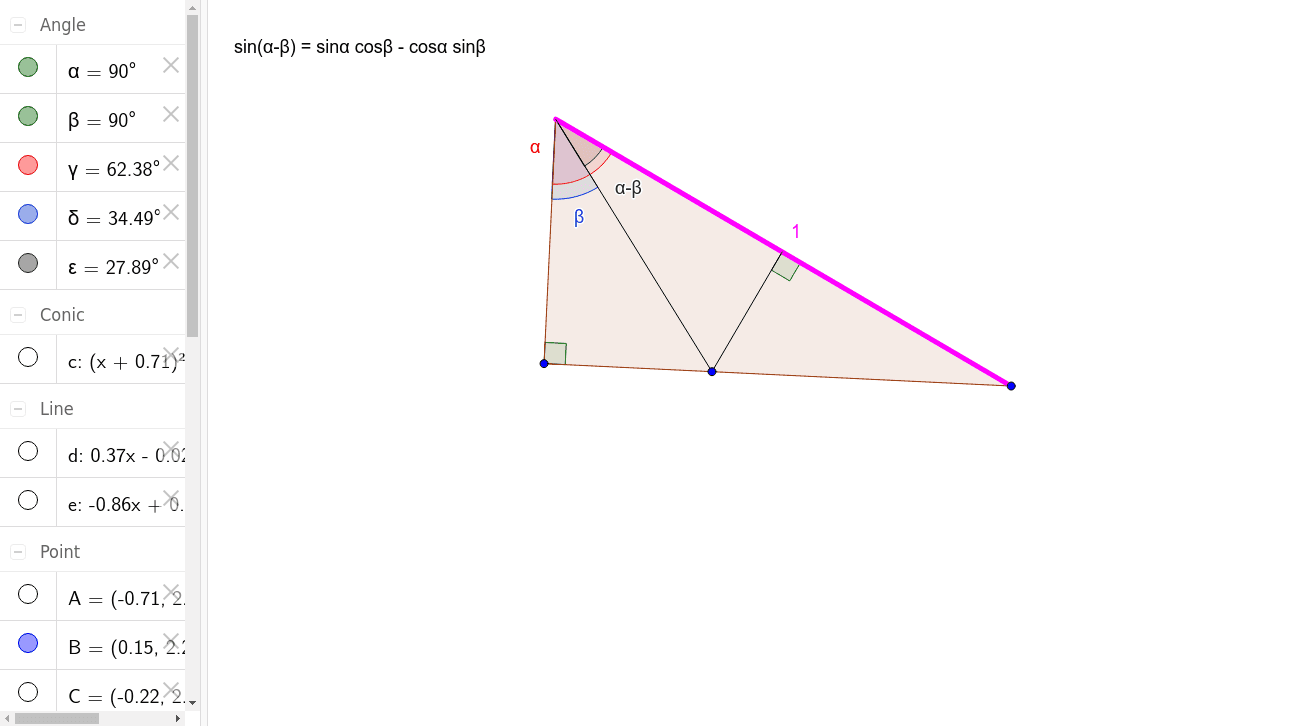
This GeoGebra example demonstrates the derivation of the sine difference formula sin(α−β) by defining unknown sides and angles in a geometric construction. It visually connects trigonometric identities with geometric relationships, including the use of geometric mean and an incircle. The construction employs commands such as Circle, Point, Segment, Ray, OrthogonalLine, Intersect, Polygon, and Angle to build the figure, with text1 displaying the formula. It is suitable for high school or early college students learning trigonometry, and serves as an interactive teaching tool for exploring how algebraic identities arise from geometry.
GeoGebra Commands & Parameters
Circle(A, 1) → cPoint(c) → BSegment(A, B) → aRay(B, C) → bOrthogonalLine(A, b) → dIntersect(d, b) → DPoint(b) → EOrthogonalLine(E, a) → eIntersect(e, a) → FPolygon(A, D, B) → poly1, b_1, a_1, d_1Segment(A, E) → fSegment(E, F) → gAngle(E, F, B) → αAngle(B, D, A) → βAngle(D, A, B) → γAngle(D, A, E) → δAngle(E, A, B) → ε
AI Drawing Prompt Reference
Draw a unit circle with a center point and another point on the circle, connected by a radius. From an external point, draw a ray that intersects the circle's extension. Construct a line through the center perpendicular to this ray, meeting the ray at a point. Choose another point on the ray and drop a perpendicular from it to the radius, marking the foot. Connect the center, the foot, and the ray intersection to form a triangle, and also connect the center to the second ray point and that point to the foot. Label five angles: at the foot, at the ray intersection, at the center, and two angles between the center and the two ray points. The figure illustrates the geometric derivation of the sine difference formula.
The prompt above was compiled from the original drawing commands and is for reference only.