
Geometric Demonstration of the Triangle Angle Sum
Loading the math board and drawing, please wait…
In collections
About angles in a triangle
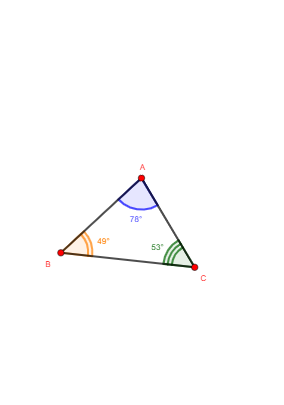
This example demonstrates—via an interactive geometric construction—the invariant that the three interior angles of a triangle add up to a fixed value. It uses the relationships between angles created by triangle sides together with auxiliary lines (e.g., tangent/line structures) to visually and quantitatively confirm the triangle angle sum. Key concepts include measuring triangle interior angles, angle addition, and angle relationships derived from auxiliary constructions. In GeoGebra, the construction mainly relies on Segment and Angle to create the triangle (points A, B, C and the sides between them) and to define angle objects (α, β, γ). Additional helper objects (lines labeled f, g, h and points D, E, F, G, etc.) support the tangent/auxiliary-angle setup, while text labels and answer lists (text*, AnsList*) display and track angle measures. The example is suitable for middle school geometry lessons, interactive verification of the angle-sum theorem, and self-paced learning.
GeoGebra Commands & Parameters
Segment(A, B) → fSegment(B, C) → gSegment(C, A) → hAngle(C, A, B) → αAngle(B, C, A) → βAngle(A, B, C) → γSegment(A, A + C - B) → iSegment(A, A + B - C) → jSegment(A, (2 * A) - C) → kSegment(A, (2 * A) - B) → lAngle((2 * A) - B, A, (2 * A) - C) → δAngle((2 * A) - C, A, A + B - C) → εAngle(A + C - B, A, (2 * A) - B) → ζ
AI Drawing Prompt Reference
Draw a triangle and measure its three interior angles α, β, γ, showing their sum. Construct three angles δ, ε, ζ using auxiliary lines and display their measures to verify the triangle angle sum theorem. Use auxiliary segments and angles to create the construction, labeling key angle relationships for a clear geometric demonstration.
The prompt above was compiled from the original drawing commands and is for reference only.