
Geometric Construction: Symmetry of Parabola and Circle
Loading the math board and drawing, please wait…
In collections
geometriadinamica.es
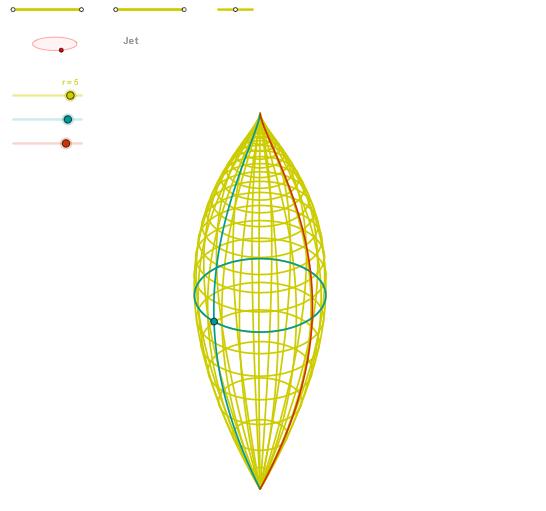
This example demonstrates the symmetry of a parabola and a circle. Key mathematical concepts include parabola, circle, and symmetry. It is constructed using GeoGebra commands such as Segment, Point, OrthogonalLine, Circle, Intersect, etc. Suitable for high school mathematics education and learning.
GeoGebra Commands & Parameters
Segment(Q3, Q4) → p2Point(p2) → P3Segment(P3, Q4) → p4Point(p4) → P4Segment(Q1, Q2) → p1Point(p1) → P1Segment(P1, Q2) → p3Point(p3) → P2OrthogonalLine(C, xAxis) → zz2Circle(C, 0.62) → zz0Intersect(zz0, zz2, 1) → ZZ4Intersect(zz0, zz2, 2) → ZZ3Ellipse(ZZ3, ZZ4, 0.65) → zElipse2Point(zElipse2) → ZIntersect(zElipse2, zz2) → ZZ7, ZZ8Angle(ZZ8, C, Z) → zAngIncOrthogonalLine(C, yAxis) → zz1Intersect(zz0, zz1, 2) → ZZ2Intersect(zz0, zz1, 1) → ZZ1Ellipse(ZZ1, ZZ2, 0.65) → zElipse1Point(zElipse1) → XYIntersect(zElipse1, zz1) → ZZ5, ZZ6Angle(ZZ6, C, XY) → zAngRotSegment(Q5, Q6) → p5Point(p5) → P5Segment(ZZ5, ZZ6) → zz4Segment(ZZ7, ZZ8) → zz3Intersect(zElipse2, zElipse1, 1) → zPunto1Intersect(zElipse2, zElipse1, 4) → zPunto2Segment(zPunto1, zPunto2) → zSeg2CurveCartesian((r / 4 * (((((1 - cosh(α)) * sin(α)) * cos(v) / 2) * sin(zAngRot)) + ((((1 - cosh(α)) * sin(α)) * sin(v) / 2) * cos(zAngRot)))), (r / 4 * ((((((-(1 - cosh(α))) * sin(α)) * cos(v) / 2) * cos(zAngRot)) * sin(zAngInc)) + (((((1 - cosh(α)) * sin(α)) * sin(v) / 2) * sin(zAngRot)) * sin(zAngInc)) + (cosh(α) * cos(zAngInc)))) + 6, v, v1, v2) → curva2CurveCartesian((r / 4 * (((-(1 - cosh(u))) * sin(u) / 2) * sin(zAngRot))), (r / 4 * (((((1 - cosh(u)) * sin(u) / 2) * cos(zAngRot)) * sin(zAngInc)) + (cosh(u) * cos(zAngInc)))) + 6, u, u1, u2) → curva1CurveCartesian((r / 4 * (((((1 - cosh(u)) * sin(u)) * cos(β) / 2) * sin(zAngRot)) + ((((1 - cosh(u)) * sin(u)) * sin(β) / 2) * cos(zAngRot)))), (r / 4 * ((((((-(1 - cosh(u))) * sin(u)) * cos(β) / 2) * cos(zAngRot)) * sin(zAngInc)) + (((((1 - cosh(u)) * sin(u)) * sin(β) / 2) * sin(zAngRot)) * sin(zAngInc)) + (cosh(u) * cos(zAngInc)))) + 6, u, u1, u2) → a1Sequence(CurveCartesian[(r / 4 * (((((1 - cosh(u)) * sin(u)) * cos(v) / 2) * sin(zAngRot)) + ((((1 - cosh(u)) * sin(u)) * sin(v) / 2) * cos(zAngRot)))), (r / 4 * ((((((-(1 - cosh(u))) * sin(u)) * cos(v) / 2) * cos(zAngRot)) * sin(zAngInc)) + (((((1 - cosh(u)) * sin(u)) * sin(v) / 2) * sin(zAngRot)) * sin(zAngInc)) + (cosh(u) * cos(zAngInc)))) + 6, v, v1, v2], u, u1, u2, paso) → list2Sequence(CurveCartesian[(r / 4 * (((((1 - cosh(u)) * sin(u)) * cos(v) / 2) * sin(zAngRot)) + ((((1 - cosh(u)) * sin(u)) * sin(v) / 2) * cos(zAngRot)))), (r / 4 * ((((((-(1 - cosh(u))) * sin(u)) * cos(v) / 2) * cos(zAngRot)) * sin(zAngInc)) + (((((1 - cosh(u)) * sin(u)) * sin(v) / 2) * sin(zAngRot)) * sin(zAngInc)) + (cosh(u) * cos(zAngInc)))) + 6, u, u1, u2], v, v1, v2, (3 * paso)) → list1
AI Drawing Prompt Reference
In the same coordinate plane, draw the x-axis and y-axis, and construct a circle centered at C with radius about 0.62. Draw two lines perpendicular to the axes through C and find their intersections with the circle to obtain key intersection points. Using those points as defining points for major axes, construct two ellipses, arranged to reflect a symmetry between them. Locate intersection points involving one ellipse, the other ellipse, and the axis-related lines, then connect the relevant points with a segment. Determine angle directions from those intersections, and use them to plot two parametric curves with different parameter variables, placed with the same angle settings to visualize the symmetry relationship among the circle, ellipses, and resulting curves.
The prompt above was compiled from the original drawing commands and is for reference only.