
Geometric Construction of Inscribed Polygons and Rectangle Division in a Unit Ci
Loading the math board and drawing, please wait…
In collections
Polygons: first steps (GER)
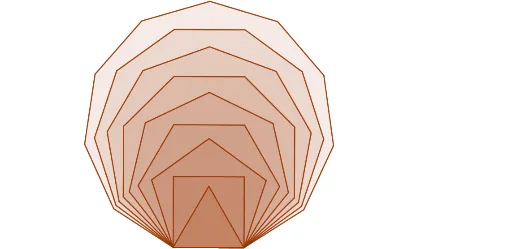
①This example demonstrates a geometric construction involving multiple polygons (including rectangles) formed by midpoints inside a unit circle, showing the positional relationships between inscribed polygons and rectangles. ②Core mathematical concepts include the unit circle, polygons (especially rectangles), midpoints, and polygon division/area partitioning, with implicit connections to functions and coordinates. ③Construction highlights: Based on the construction summary, the GeoGebra commands Polygon and Midpoint are used, creating multiple points (A, B, C, D, E, F, G, H, I, J, K, L) and polygon objects (Vieleck1 to Vieleck5), along with several lines or functions (f, g, h, i, j, k, l, m, n, p, q, r, s, t, a, b, c, d, e, f_1, g_1, h_1, i_1), which together form a complex geometric division structure. ④This is suitable for middle or high school geometry teaching or math lab activities, for exploring properties of inscribed polygons, midpoint connection patterns, and geometric intuition of polygon division, as well as dynamic geometry demonstrations.
GeoGebra Commands & Parameters
Polygon(A, B, 3) → Vieleck1, f, g, h, CPolygon(A, B, 4) → Vieleck2, i, j, k, l, D, EPolygon(A, B, 5) → Vieleck3, m, n, p, q, r, F, G, HPolygon(A, B, 6) → Vieleck4, s, L, t, a, b, c, d, I, J, KPolygon(A, B, 7) → Vieleck5, e, O, P, Q, f_1, g_1, h_1, i_1, j_1, k_1, M, NPolygon(A, B, 8) → Vieleck6, l_1, S, T, U, V, W, m_1, n_1, p_1, q_1, r_1, s_1, t_1, RPolygon(A, B, 9) → Vieleck7, a_1, Z, A_1, B_1, C_1, D_1, E_1, F_1, b_1, c_1, d_1, e_1, f_2, g_2, h_2, i_2Polygon(A, B, 10) → Vieleck8, j_2, t_2, G_1, H_1, I_1, J_1, K_1, L_1, M_1, N_1, k_2, l_2, m_2, n_2, p_2, q_2, r_2, s_2Polygon(A, B, 11) → Vieleck9, a_2, j_3, k_3, O_1, P_1, Q_1, R_1, S_1, T_1, U_1, V_1, b_2, W_1, c_2, d_2, e_2, f_3, g_3, h_3, i_3Midpoint(E, O) → Z_1Midpoint(D, O) → A_2Midpoint(C_1, K) → C_2Midpoint(C_1, J) → D_2Midpoint(T, S_1) → B_2Midpoint(U, S_1) → E_2
AI Drawing Prompt Reference
Inside a unit circle, construct a series of regular polygons sharing a common base edge, starting with a triangle, then a square, pentagon, up to an undecagon, totaling nine polygons. All vertices lie on the circle, creating nested symmetric layers. Then, select vertices from different polygons and connect midpoints of opposite sides to generate internal segments, partitioning the circular region into smaller polygons. This reveals relationships between midpoint connections and polygon division. The overall figure is centered at the circle's center, featuring a complex pattern of radial and concentric elements, ideal for studying inscribed polygon properties and midpoint partitioning.
The prompt above was compiled from the original drawing commands and is for reference only.