
Geometric Construction and Locus Demonstration of the First Definition of a Para
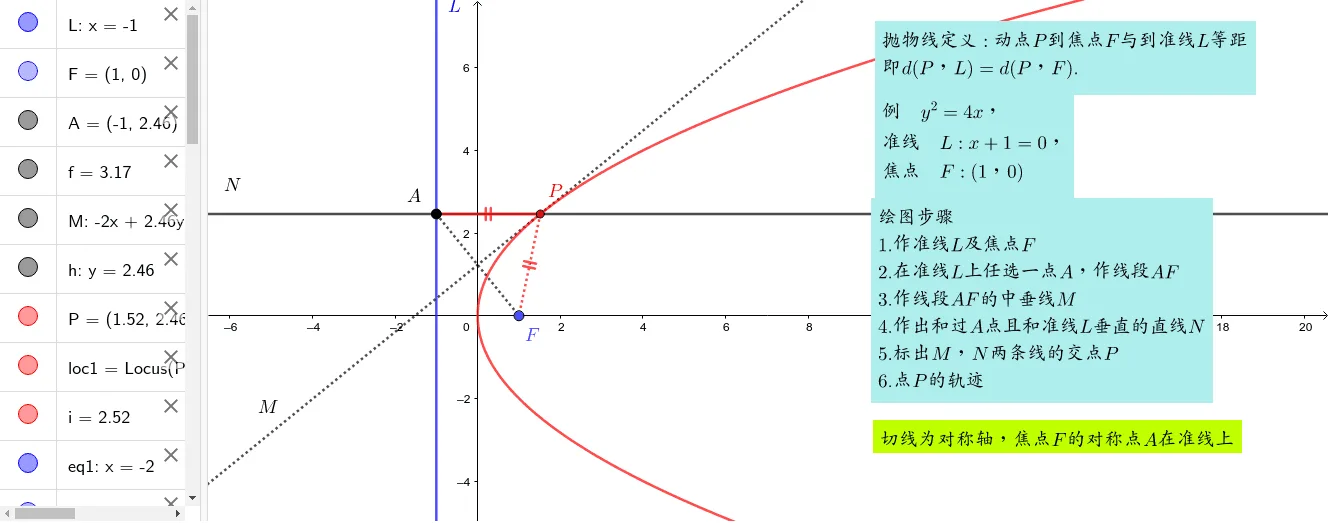
This GeoGebra example dynamically demonstrates the first definition of a parabola through geometric construction. It includes a focus F and a directrix L, using the intersection of a perpendicular bisector and an orthogonal line to generate a locus. This visually illustrates the geometric property that any point on the parabola is equidistant from the focus and the directrix. Auxiliary elements such as circles and line segments are incorporated to support deeper understanding. Students can manipulate the position of a point on the directrix and observe how the perpendicular bisector of the segment connecting that point to the focus intersects with the perpendicular from that point to the directrix, tracing out the parabolic curve. This interactive exploration reinforces the core concept that a parabola is the set of all points in a plane that are equidistant from a fixed point (the focus) and a fixed line (the directrix). The applet also allows learners to adjust the parameter p, which represents the distance between the focus and the directrix, thereby observing how changes in this parameter affect the shape and width of the parabola. By combining static geometric constructions with dynamic locus generation, this tool provides a multi-layered visual experience that bridges intuition and formal definition, making it particularly effective for students encountering conic sections for the first time or seeking a deeper geometric understanding of the parabola beyond its algebraic equation y squared equals four p x.
Loading the math board and drawing, please wait…