
GeoGebra Drill: Divisibility by 9 with a “splat/ink blot” number task
Loading the math board and drawing, please wait…
In collections
Teilbarkeitsregeln
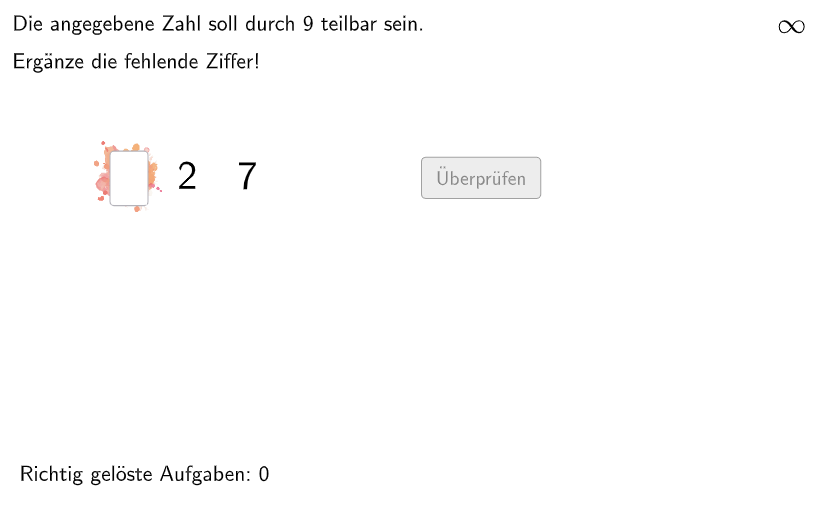
This GeoGebra example demonstrates divisibility by 9 using an “ink blot/splat” style visualization that represents randomly assembled digits, helping students decide whether a number is divisible by 9. The key math ideas are divisibility, factors and multiples, and the rule that a number is divisible by 9 exactly when the sum of its digits is a multiple of 9 (equivalently, the appropriate congruence). Construction and interaction focus on generating digit combinations from randomized inputs, visualizing the corresponding graphical elements, and then validating the student’s reasoning against the correct result. It is built with commands such as Textfield, Shuffle, and Join for question setup and randomization; Polygon, Distance, Element, Append, Remove, and If for creating/adjusting geometric objects and applying conditional logic. Interactive objects like validate/solution display and counters (showanswer, showsolution, btnValidate, attemptCount, correctCount, btnTryAgain, btnNew, showhint) support hints, retry, and feedback. Suitable for primary students (grades 5–6) for practicing and explaining divisibility rules in an interactive way.
GeoGebra Commands & Parameters
Textfield(input1) → InputBox1Textfield(input2) → InputBox2Shuffle(1…9) → Num1List, {7, 8, 4, 1, 9, 5, 2, 6, 3}Shuffle(0…9) → Num2List, {2, 5, 7, 9, 8, 0, 3, 4, 6, 1}Shuffle(0…9) → Num3List, {7, 5, 4, 2, 9, 3, 6, 0, 8, 1}Shuffle(0…9) → Num4List, {9, 3, 6, 1, 0, 8, 7, 2, 4, 5}Shuffle(Join[Sequence[{3, 4, 5}, i, 1, 10]]) → HelperList, {4, 4, 5, 5, 3, 3, 3, 3, 3, 3, 5, 5, 4, 5, 3, 5, 4, 3, 5, 4, 4, 5, 4, 5, 5, 3, 4, 3, 4, 4}Join({{3}, HelperList}) → StellenAnzahlListShuffle(1…stellenanzahl) → exList, {1, 2, 3}Shuffle(0…9) → Num5List, {0, 2, 5, 9, 8, 4, 1, 3, 7, 6}Polygon(PtopLeftCornerFeedback, PtopRightCornerFeedback, PbottomRightCornerFeedback, PbottomLeftCornerFeedback) → rectangleCorrect, rectangleCorrectS3, rectangleCorrectS4, rectangleCorrectS2, rectangleCorrectS1Shuffle(Sequence[Random[0, 10], i, 1, 100]) → randomNosForX, {4, 5, 10, 9, 4, 7, 3, 3, 1, 4, 3, 8, 7, 9, 8, 10, 3, 0, 4, 10, 4, 3, 0, 3, 3, 3, 6, 0, 10, 8, 8, 4, 2, 10, 8, 0, 10, 6, 8, 2, 10, 3, 4, 5, 1, 3, 9, 3, 6, 10, 10, 4, 8, 8, 7, 0, 7, 8, 10, 2, 7, 10, 9, 0, 1, 9, 1, 9, 3, 3, 1, 1, 9, 3, 8, 2, 0, 8, 1, 1, 9, 5, 3, 10, 3, 4, 4, 0, 6, 1, 9, 9, 5, 7, 3, 2, 2, 7, 5, 5}Element(randomNosForX, Mod[questionCount, 100] + 1) → numXShuffle(Sequence[Random[0, 10], i, 1, 100]) → randomNosForY, {5, 6, 0, 4, 10, 1, 0, 8, 6, 4, 9, 0, 7, 2, 2, 1, 4, 9, 6, 4, 8, 10, 0, 9, 1, 0, 9, 3, 4, 8, 7, 3, 1, 1, 6, 9, 4, 3, 5, 6, 9, 3, 8, 6, 8, 1, 7, 8, 6, 3, 4, 3, 5, 6, 6, 1, 2, 8, 2, 5, 7, 1, 10, 2, 6, 7, 7, 7, 9, 5, 6, 10, 6, 8, 10, 4, 10, 5, 4, 9, 6, 6, 8, 0, 4, 0, 2, 3, 9, 3, 9, 8, 6, 9, 8, 3, 1, 2, 3, 6}Element(randomNosForY, Mod[questionCount, 100] + 1) → numYAppend(true, Sequence[If[randomNosForX(i) ≟ randomNosForX(i - 1), false, true], i, 2, 100]) → stayXAppend(true, Sequence[If[randomNosForY(i) ≟ randomNosForY(i - 1), false, true], i, 2, 100]) → stayYRemove(Sequence[If[stayX(i), randomNosForX(i), 0], i, 1, 100], Sequence[0, i, 1, 100]) → randomNosForXwithoutRepeatRemove(Sequence[If[stayY(i), randomNosForY(i), 0], i, 1, 100], Sequence[0, i, 1, 100]) → randomNosForYwithoutRepeatElement(randomNosForXwithoutRepeat, Mod[questionCount, Length[randomNosForXwithoutRepeat]] + 1) → numXwithoutRepeatElement(randomNosForYwithoutRepeat, Mod[questionCount, Length[randomNosForYwithoutRepeat]] + 1) → numYwithoutRepeatTextfield(input3) → InputBox3Textfield(input4) → InputBox4If(multiplesol, 9, 9 - Mod[ziffernsummeohneinput, 9]) → solTextfield(input5) → InputBox5Distance(G, H) → a
AI Drawing Prompt Reference
Draw a graph with randomly arranged numbers, containing a rectangle whose color depends on the divisibility of the numbers by 9. The numbers should be colored red if they are not divisible by 9 and blue if they are. The size of the numbers should be proportional to their values. The graph may also include some auxiliary lines and points to help users determine the divisibility of the numbers.
The prompt above was compiled from the original drawing commands and is for reference only.