
Galaxy Spiral Model
Loading the math board and drawing, please wait…
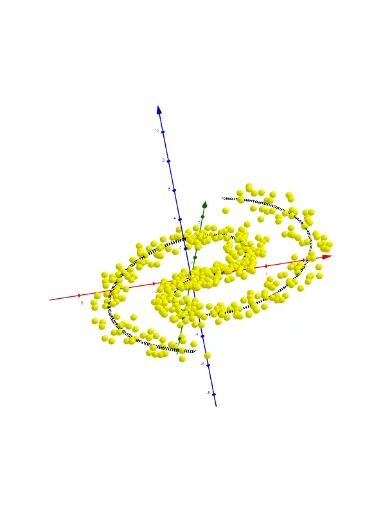
This example demonstrates the construction and dynamic behavior of a spiral galaxy model. It involves core mathematical concepts like coordinate geometry, vector operations, trigonometry, and parametric equations. Key GeoGebra commands used include CurveCartesian for curve plotting, Rotate for rotation, Sequence for generating sequences, and Length for length calculations. Suitable for high school students and mathematics enthusiasts studying spatial geometry and dynamic geometric modeling.
GeoGebra Commands & Parameters
CurveCartesian(((sp_1 * ℯ^((θ * cot(sp_2)))); θ), θ, 0, sp_3) → cRotate(c, 180° + α, A) → c'Rotate(c, 0*° + α, A) → c'_1Sequence(c'(i) + (Random[(v_{min} * 10), (v_{max} * 10)] / 10, Random[(v_{min} * 10), (v_{max} * 10)] / 10), i, 0, sp_3, (2 * sp_3 / (n - 1))) → L_3Sequence(c'_1(i), i, 0, sp_3, n) → L_2Sequence(c'(i), i, 0, sp_3, n) → L_1Length(L_3) → s1Length(L_3) → s2Sequence(c'_1(i) + (Random[(v_{min} * 10), (v_{max} * 10)] / 10, Random[(v_{min} * 10), (v_{max} * 10)] / 10), i, 0, sp_3, (2 * sp_3 / (n - 1))) → L_4
AI Drawing Prompt Reference
Draw a spiral galaxy model to demonstrate its construction and dynamic behavior. The core is a spiral curve based on parametric equations, rotated and randomly perturbed to generate galaxy arms, showcasing applications of coordinate geometry, vector operations, and trigonometry. Start with a base spiral, rotate and perturb it, then generate multiple galaxy arms to create a dynamically rotating galaxy effect.
The prompt above was compiled from the original drawing commands and is for reference only.