
Function Graph & Calculus Demonstration
Loading the math board and drawing, please wait…
In collections
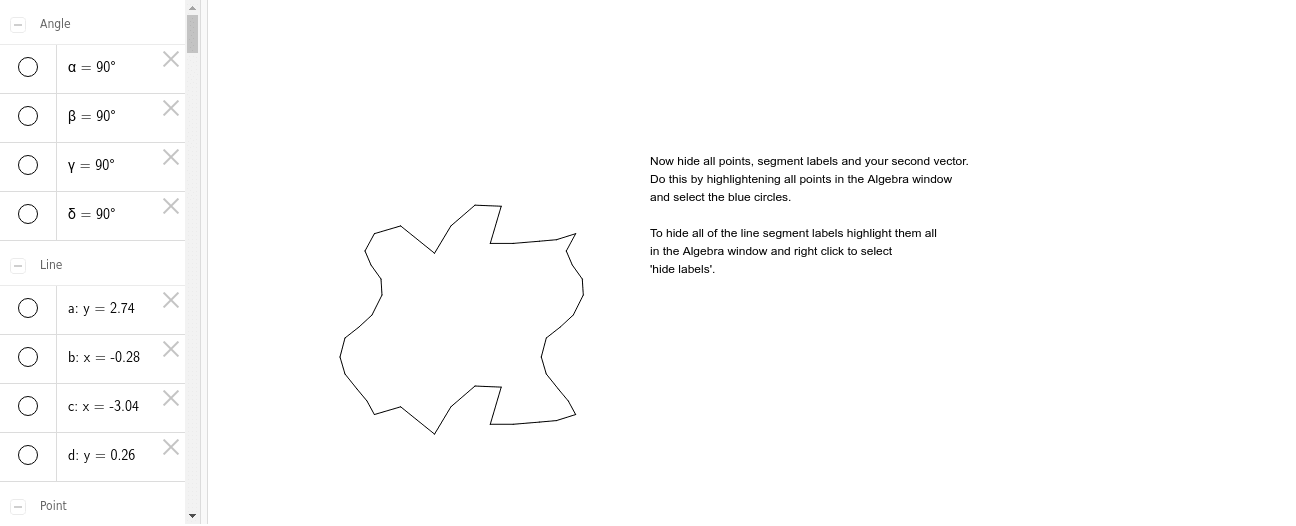
Phebe Tanner Translation Tessallation
This example dynamically demonstrates the relationship between function graphs, derivatives, and integrals, visually showcasing core calculus concepts. It involves function graphs, differential calculus, indefinite integrals, and parabolas. Construction highlights include commands like Line, OrthogonalLine, Point, Intersect, Segment, Angle, Vector, and Translate from GeoGebra, emphasizing geometric and analytical techniques. Ideal for high school students and math enthusiasts exploring function properties and calculus applications.
GeoGebra Commands & Parameters
Line(A, B) → aOrthogonalLine(B, a) → bOrthogonalLine(A, a) → cPoint(b) → COrthogonalLine(C, c) → dIntersect(c, d) → DSegment(D, C) → eSegment(C, B) → fSegment(B, A) → gSegment(A, D) → hAngle(A, B, C) → αAngle(C, D, A) → βAngle(D, A, B) → γAngle(B, C, D) → δSegment(D, E) → iSegment(E, F) → jSegment(F, G) → kSegment(G, H) → lSegment(H, I) → mSegment(I, J) → nSegment(J, K) → pSegment(K, L) → qSegment(L, M) → rSegment(M, C) → sVector(C, B) → uTranslate(D, u) → D'Translate(E, u) → E'Segment(D', E') → i'Translate(E, u) → E'_1Translate(F, u) → F'Segment(E'_1, F') → j'Translate(F, u) → F'_1Translate(G, u) → G'Segment(F'_1, G') → k'Translate(G, u) → G'_1Translate(H, u) → H'Segment(G'_1, H') → l'Translate(H, u) → H'_1Translate(I, u) → I'Segment(H'_1, I') → m'Translate(I, u) → I'_1Translate(J, u) → J'Segment(I'_1, J') → n'Translate(J, u) → J'_1Translate(K, u) → K'Segment(J'_1, K') → p'Translate(K, u) → K'_1Translate(L, u) → L'Segment(K'_1, L') → q'Translate(L, u) → L'_1Translate(M, u) → M'Segment(L'_1, M') → r'Translate(M, u) → M'_1Translate(C, u) → C'Segment(M'_1, C') → s'Segment(D, N) → tSegment(N, O) → a_1Segment(O, P) → b_1Segment(P, Q) → c_1Segment(Q, R) → d_1Segment(R, S) → e_1Segment(S, T) → f_1Segment(T, U) → g_1Segment(U, V) → h_1Segment(V, W) → i_1Segment(W, Z) → j_1Segment(Z, A) → k_1Vector(A, B) → vTranslate(D, v) → D'_1Translate(N, v) → N'Segment(D'_1, N') → t'Translate(N, v) → N'_1Translate(O, v) → O'Segment(N'_1, O') → l_1Translate(O, v) → O'_1Translate(P, v) → P'Segment(O'_1, P') → m_1Translate(P, v) → P'_1Translate(Q, v) → Q'Segment(P'_1, Q') → n_1Translate(Q, v) → Q'_1Translate(R, v) → R'Segment(Q'_1, R') → p_1Translate(R, v) → R'_1Translate(S, v) → S'Segment(R'_1, S') → q_1Translate(S, v) → S'_1Translate(T, v) → T'Segment(S'_1, T') → r_1Translate(T, v) → T'_1Translate(U, v) → U'Segment(T'_1, U') → s_1Translate(U, v) → U'_1Translate(V, v) → V'Segment(U'_1, V') → t_1Translate(V, v) → V'_1Translate(W, v) → W'Segment(V'_1, W') → a_2Translate(W, v) → W'_1Translate(Z, v) → Z'Segment(W'_1, Z') → b_2Translate(Z, v) → Z'_1Translate(A, v) → A'Segment(Z'_1, A') → c_2Translate(D', v) → D''
AI Drawing Prompt Reference
Draw a geometric figure with two parallel lines and a slanted line, with perpendiculars from the slanted line's endpoints to the parallel lines, creating four intersection points. Connect these points to form a quadrilateral and label its four interior angles. From one vertex of the quadrilateral, draw a series of equally spaced parallel segments along one side, extending to the opposite side. Then translate all these segments in the same direction to create a shifted set, demonstrating a translation transformation.
The prompt above was compiled from the original drawing commands and is for reference only.