
Fun Geometry Construction: Angles, Circles, and Matrix Interaction
Loading the math board and drawing, please wait…
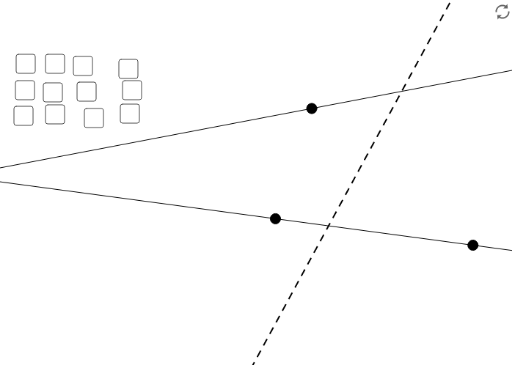
① This example demonstrates a dynamic geometric construction involving points, lines, circles, circular sectors, angles, and matrix-related elements, created with GeoGebra commands to form an engaging mathematical figure. ② Core mathematical concepts include angles (α, β, γ, etc.), subtraction, expected value, matrices, boxplots, and cubes, though the actual construction focuses on planar geometry with circles, sectors, intersections, and segments. ③ Construction highlights: Uses GeoGebra commands such as Line, Angle, Intersect, Point, Circle, and CircleSector; creates point objects A, B, C, D, E, F, G, H, I, J, K; line/circle objects a, b, c, d, e, f, g; defines multiple angles (α, β, γ, δ, ε, ζ, η, θ) and named angles Angle_1, Angle_2; also includes auxiliary object c_1. ④ Suitable for middle/high school geometry teaching or mathematical exploration, useful for demonstrating angle relationships, circle-line interactions, and multi-object dynamics in dynamic geometry, as well as a comprehensive case for learning GeoGebra commands.
GeoGebra Commands & Parameters
Line(A, B) → aLine(C, D) → bLine(E, F) → cAngle(c, b) → αIntersect(α, b, 1) → GIntersect(α, b, 1) → HIntersect(b, c) → IAngle(C, I, F) → βAngle(E, I, C) → γPoint(b) → JAngle(J, I, E) → δIntersect(a, c) → KAngle(B, K, I) → εAngle(I, K, A) → ζAngle(A, K, F) → ηAngle(F, K, B) → θCircle(I, 1) → c_1Circle(K, 1) → d_1Intersect(c_1, b, 2) → LIntersect(c_1, c, 1) → MIntersect(c_1, b, 1) → NIntersect(c_1, c, 2) → OIntersect(d_1, a, 2) → PIntersect(d_1, c, 1) → QIntersect(d_1, a, 1) → RIntersect(d_1, c, 2) → SCircleSector(I, L, M) → e_1CircleSector(I, M, N) → f_1CircleSector(I, N, O) → g_1CircleSector(I, O, L) → h_1CircleSector(K, P, Q) → k_1CircleSector(K, Q, R) → p_1CircleSector(K, R, S) → q_1CircleSector(K, S, P) → r_1Circle(I, 1) → s_1Circle(K, 1) → t_1Intersect(s_1, b, 2) → TIntersect(s_1, c, 1) → UIntersect(s_1, b, 1) → VIntersect(s_1, c, 2) → WIntersect(t_1, a, 2) → ZIntersect(t_1, c, 1) → A_1Intersect(t_1, a, 1) → B_1Intersect(t_1, c, 2) → C_1CircleSector(I, T, U) → c_2CircleSector(I, U, V) → d_2CircleSector(I, V, W) → e_2CircleSector(I, W, T) → f_2CircleSector(K, Z, A_1) → g_2CircleSector(K, A_1, B_1) → h_2CircleSector(K, B_1, C_1) → k_2CircleSector(K, C_1, Z) → p_2