
Fractions Lesson 1: Visualizing Fractions with Circles and Sectors
Loading the math board and drawing, please wait…
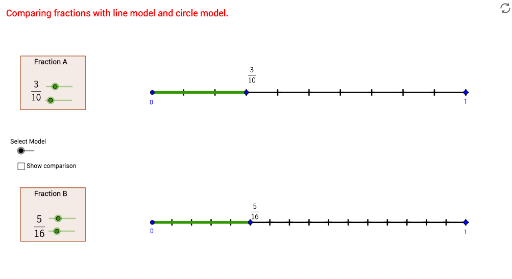
① This GeoGebra example demonstrates the concept of fractions by dividing circles into equal sectors and shading the numerator portion, making the part-whole relationship visually clear. ② Core mathematical concepts include fraction definition, unit fractions, comparing fractions, and the relationship between numerator and denominator, using circles, sectors, sequences, and vectors. ③ Construction highlights: using commands such as Segment, Sequence, Circle, Point, Rotate, CircleSector, and Polygon, the model creates two adjustable circle models with sliders for denominators and numerators, visualizes fractions via dot sequences (numdots) and colored sectors (numeratorwedge), and includes a comparison mode (showcomparison) to display which fraction is larger. ④ Suitable for upper elementary or middle school students as an introductory fraction lesson, and for teachers to use in interactive classroom demonstrations, enhancing conceptual understanding through dynamic manipulation and visual comparison.
GeoGebra Commands & Parameters
Segment(A, A + (unitsize1, 0)) → line1Segment(B, B + (unitsize2, 0)) → line2Sequence((x(A) + (i * unitsize1 / denominator1), y(A)), i, 1, denominator1) → numdots1Sequence((x(B) + (i * unitsize2 / denominator2), y(B)), i, 1, denominator2) → numdots2Segment(E, (x(E), y(E) - (y(A) - y(B)))) → showcomparison_1Segment(A, E) → showfrac1_1Segment(B, F) → showfrac2_1Circle(G, unitradius) → cPoint(c) → HSegment(G, H) → aRotate(G, (360 * ° / denominator1), G) → G'Sequence(Segment[Rotate[G, ((i * 360) * ° / denominator1), G], Rotate[H, ((i * 360) * ° / denominator1), G]], i, 1, denominator1) → denominatorwedges1Circle(I, unitradius) → dPoint(d) → JSegment(I, J) → bSequence(Segment[Rotate[I, ((i * 360) * ° / denominator2), I], Rotate[J, ((i * 360) * ° / denominator2), I]], i, 1, denominator2) → denominatorwedges2Rotate(H, ((numerator1 * 360) * ° / denominator1), G) → H'Rotate(J, ((numerator2 * 360) * ° / denominator2), I) → J'CircleSector(G, H, H') → numeratorwedge1CircleSector(I, J, J') → numeratorwedge2Polygon(K, (x(K), y(K) - boxheight), (x(K) + boxwidth, y(K) - boxheight), (x(K) + boxwidth, y(K))) → poly1, e, f, g, hPolygon(L, (x(L), y(L) - boxheight), (x(L) + boxwidth, y(L) - boxheight), (x(L) + boxwidth, y(L))) → poly2, l, i, j, k