
Fraction to Decimal by Ibrahim El Hage
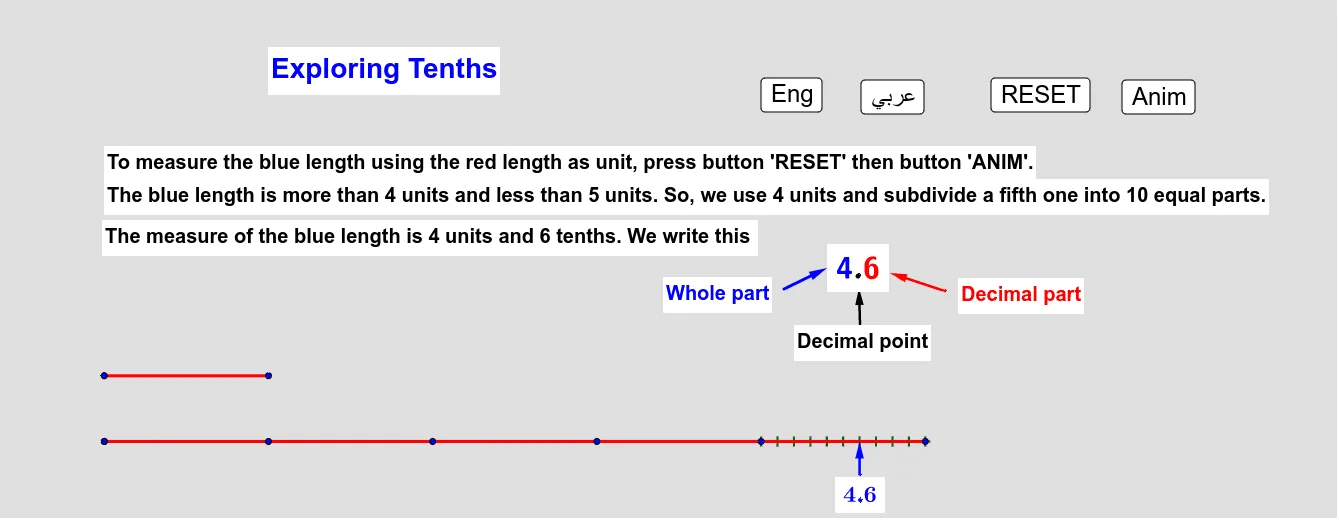
Loading the math board and drawing, please wait…
In collections
Fractions الكسور
This example demonstrates the process of converting fractions to decimals. Core mathematical concepts include fractions, decimals, decimal representation, and basic geometric transformations. It utilizes GeoGebra commands and objects such as Segment, Translate, Rotate, Sequence, and Vector, along with elements like O, A, f, B, C, g, a, B0, B1, g', α1, B2, h, b, α2, B3, i, α3, B4, j, α4, B5, k, list1, D, u, button1, button2, text1, text2, text4, text5, text6, text7, text8, E, F, v, G, H. Suitable for middle school and above students to understand the relationship between fractions and decimals and the application of geometric transformations.
GeoGebra Commands & Parameters
Segment(O, A) → fSegment(B, C) → gTranslate(B, Vector[(a * Vector[(0, -2)])]) → B0Translate(C, Vector[(a * Vector[(0, -2)])]) → B1Segment(B0, B1) → g'Rotate(B0, (-α1), B1) → B2Segment(B1, B2) → hRotate(B1, (-α2), B2) → B3Segment(B2, B3) → iRotate(B2, (-α3), B3) → B4Segment(B3, B4) → jRotate(B3, (-α4), B4) → B5Segment(B4, B5) → kSequence((20 + k, 0), k, 0, 5, 0.5) → list1Vector(D, A) → uVector(E, F) → vVector(G, H) → wVector(I, J) → c
AI Drawing Prompt Reference
Draw a geometric representation showing the conversion of fractions to decimals, starting with a line segment and evolving into a complex pattern through multiple translations and rotations. The process illustrates the geometric interpretation of decimal representation, beginning with an initial segment and sequentially transforming it using vector operations to form a series of new segments that collectively create a more intricate design, highlighting the relationship between fractions and decimals.
The prompt above was compiled from the original drawing commands and is for reference only.