
Fraction Simplification Practice
Loading the math board and drawing, please wait…
In collections
Bruchzahlen: Erweitern und Kürzen
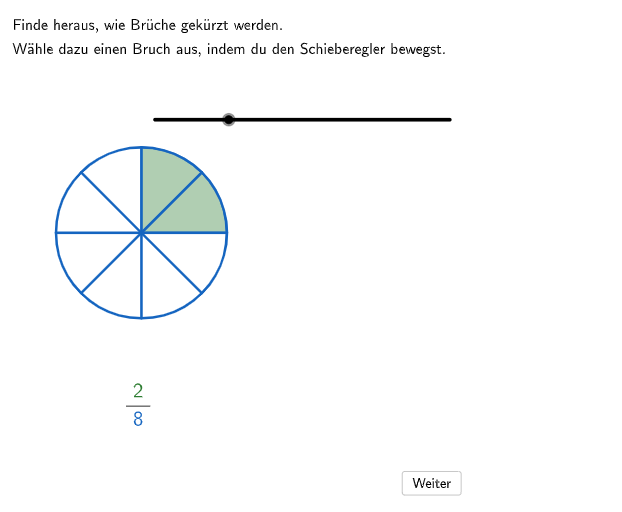
An interactive GeoGebra exercise for mastering fraction simplification through diverse question types. Core mathematical concepts: finding greatest common divisors, determining whether fractions can be simplified, understanding that simplification does not change the fraction's value. Construction highlights: Textfield for answer input, CountIf and If commands for answer checking, Sequence for generating number options, LaTeX for mathematical notation. Objects include listZähler (numerator list), listNenner (denominator list), and durchschnittTeiler (GCD) for simplification validation. Suitable for grades 5-6 students or fraction operation review sessions.
GeoGebra Commands & Parameters
Intersection(DivisorsList[nenner2], DivisorsList[zaehler2]) → durchschnittTeilerCircle(MidPoint, pointKreis1) → kreis1Join({{"$\textsf{\vphantom{Äg}\phantom{=}}$"}, Sequence[(("$\textsf{\vphantom{Äg}" * AufgabenText(i)) * "}$"), i, 1, CountIf[x ≠ "" ∨ x ≠ 0, AufgabenText]]}) → LDP1CountIf(x ≠ 0, durchschnittTeiler) → anzahlTeilerIf(¬recSplit, (x(pointAreaLeft2), y(pointAreaLeft4)), pointAreaLeft4 + (((If[zaehler2 > nenner2 / 2, zaehler2 - nenner2 / 2, zaehler2] * 2) * dxRectangle / nenner2), 0)) → pointAreaLeft3Sequence(Random[2, 12], i, 1, 100) → randomNenner, {9, 6, 10, 4, 12, 4, 5, 2, 5, 3, 2, 6, 9, 5, 10, 7, 7, 2, 10, 10, 6, 4, 7, 7, 5, 4, 4, 2, 3, 6, 7, 7, 4, 7, 7, 4, 7, 12, 5, 2, 3, 5, 6, 2, 10, 3, 11, 7, 3, 9, 10, 10, 6, 6, 10, 5, 7, 8, 2, 12, 8, 11, 8, 7, 10, 4, 12, 5, 5, 4, 5, 10, 12, 6, 4, 8, 8, 10, 5, 2, 4, 7, 4, 7, 2, 9, 10, 2, 9, 5, 12, 5, 4, 9, 12, 5, 9, 8, 4, 4}Sequence(Random[2, nenner2 - 1], i, 1, 100) → randomZaehler, {6, 6, 2, 3, 2, 4, 7, 5, 5, 5, 2, 4, 5, 3, 6, 2, 2, 6, 5, 4, 7, 4, 3, 7, 5, 6, 2, 7, 4, 2, 5, 5, 6, 2, 5, 5, 5, 5, 5, 5, 5, 7, 4, 6, 2, 5, 7, 5, 4, 7, 7, 3, 3, 7, 3, 3, 2, 3, 7, 4, 6, 2, 7, 5, 4, 3, 4, 6, 3, 6, 3, 3, 4, 2, 7, 7, 7, 7, 5, 3, 6, 2, 3, 3, 7, 4, 4, 5, 6, 2, 5, 3, 3, 5, 3, 4, 3, 2, 5, 3}Sequence(I + ((i * widthNennerBar / 12) * (1, 0)), i, 1, 12) → allowedPositionsNennerBarPoint(allowedPositionsNennerBar) → PNennerCircle(M, B) → cSegment(M, M + (Radius[c] * (0, 1))) → fVector(F, G) → uSegment(H, H + (widthZaehlerBar * (1, 0))) → gSegment(I, I + (widthNennerBar * (1, 0))) → hSequence(H + ((i * widthZaehlerBar / 12) * (1, 0)), i, 0, nenner2) → allowedPositionsZaehlerBarPoint(allowedPositionsZaehlerBar) → PZaehlerSequence(Rotate[f, ((i * 2) * pi / nenner2), M], i, 0, nenner2 - 1) → listAreaLeft_{1}Sequence(CircleSector[MidPoint, Rotate[KreisOben, (((-(i + 1)) * 2) * pi / nenner2), MidPoint], Rotate[KreisOben, (((-i) * 2) * pi / nenner2) - 0.0001, MidPoint]], i, 0, zaehler2 - 1) → listAreaLeftCircleSequence(Random[1, zaehler2 - 1], i, 1, 100) → randomSubtrahend, {1, 1, 1, 1, 1, 1, 1, 1, 1, 1, 1, 1, 1, 1, 1, 1, 1, 1, 1, 1, 1, 1, 1, 1, 1, 1, 1, 1, 1, 1, 1, 1, 1, 1, 1, 1, 1, 1, 1, 1, 1, 1, 1, 1, 1, 1, 1, 1, 1, 1, 1, 1, 1, 1, 1, 1, 1, 1, 1, 1, 1, 1, 1, 1, 1, 1, 1, 1, 1, 1, 1, 1, 1, 1, 1, 1, 1, 1, 1, 1, 1, 1, 1, 1, 1, 1, 1, 1, 1, 1, 1, 1, 1, 1, 1, 1, 1, 1, 1, 1}Center(sektor12v1) → M12v1Center(sektor12v2) → M12v2Center(sektor12v3) → M12v3Center(sektor12v4) → M12v4Center(sektor12v5) → M12v5Center(sektor12v6) → M12v6Center(sektor12v7) → M12v7Center(sektor12v8) → M12v8Center(sektor12v9) → M12v9Center(sektor12v10) → M12v10Center(sektor12v11) → M12v11Center(sektor12v12) → M12v12Textfield(input1) → Eingabefeld1Textfield(input2) → Eingabefeld2Join({{"$\textsf{\vphantom{Äg}Wähle aus!}$"}, Sequence[(("$\textsf{\vphantom{Äg}" * AufgabenText(i)) * "}$"), i, 1, CountIf[x ≠ "" ∨ x ≠ 0, AufgabenText]]}) → LDP1_{1}Join({{"$\textsf{\vphantom{Äg}Wähle aus!}$"}, Sequence[(("$\textsf{\vphantom{Äg}" * AufgabenText(i)) * "}$"), i, 1, CountIf[x ≠ "" ∨ x ≠ 0, AufgabenText]]}) → LDP2Point(xAxis) → JOrthogonalLine(J, xAxis) → iPoint(xAxis) → KLineBisector(K, J) → jTranslate({listAreaLeftCircle}, (dxBruch2, 0)) → showBruch201Sequence(Rotate[f, ((i * 2) * pi / ((verfeinerung * nenner2))), M], i, 0, (verfeinerung * nenner2) - 1) → l3Translate({l3}, (dxBruch2, 0)) → showBruch202Translate({c, listAreaLeft_{1}}, (dxBruch2, 0)) → showBruch203LaTeX(step, true, true) → Text5CircleArc(O, N, PosBogerl) → bogerl11Point(bogerl11) → pointBogerl1Vector(pointBogerl1, N + (0.1 * Vector[pointBogerl1, N])) → bogerl1pfeilOrthogonalLine(Q, yAxis) → kSequence(7) → listStepsMin(listSteps) → MinMax(listSteps) → MaxSegment(pointFrame3, pointFrame2) → lineLeftHorizontalSegment(pointFrame2, pointFrame1) → lineLeftVerticalJoin({Sequence[Segment[Translate[pointFrame2, (i * If[nenner2 ≟ 2, (i * dxRectangle / nenner2), ((dxRectangle * If[Mod[nenner2, 2] ≟ 0, 2, 1] / nenner2), 0)])], Translate[pointFrame1, (i * If[nenner2 ≟ 2, (i * dxRectangle / nenner2), ((dxRectangle * If[Mod[nenner2, 2] ≟ 0, 2, 1] / nenner2), 0)])]], i, 0, (nenner2 * If[Mod[nenner2, 2] ≟ 0, 0.5, 1])], Sequence[Segment[Translate[pointFrame3, (i * If[Mod[nenner2, 2] ≟ 0 ∧ nenner2 ≠ 2, (0, dyRectangle / 2), (0, dyRectangle)])], Translate[pointFrame2, (i * If[Mod[nenner2, 2] ≟ 0 ∧ nenner2 ≠ 2, (0, dyRectangle / 2), (0, dyRectangle)])]], i, 0, If[Mod[nenner2, 2] ≟ 0 ∧ nenner2 ≠ 2, 2, 1]]}) → listLeftLinesVerticalJoin({{lineLeftHorizontal, lineLeftVertical}, {Segment[Translate[pointFrame3, (0, dyRectangle)], Translate[pointFrame2, (0, dyRectangle)]]}, {Segment[Translate[pointFrame2, (dxRectangle, 0)], Translate[pointFrame1, (dxRectangle, 0)]]}}) → listFrameLeftTranslate(listFrameLeft, (dxShift, 0)) → listFrameRightTranslate(listAreaLeft, (dxShift, 0)) → listAreaRightIntersection(DivisorsList[zaehler2], DivisorsList[nenner2]) → l1Join({Sequence[Translate[Segment[Translate[pointFrame2, (dxShift, 0)], Translate[pointFrame1, (dxShift, 0)]], (i * If[nenner3 ≟ 2, (i * dxRectangle / nenner3), ((dxRectangle * If[Mod[nenner3, 2] ≟ 0, 2, 1] / nenner3), 0)])], i, 0, (nenner3 * If[Mod[nenner3, 2] ≟ 0, 0.5, 1])], Sequence[Translate[Segment[Translate[pointFrame3, (dxShift, 0)], Translate[pointFrame2, (dxShift, 0)]], (i * If[Mod[nenner3, 2] ≟ 0 ∧ nenner3 ≠ 2, (0, dyRectangle / 2), (0, dyRectangle)])], i, 0, If[Mod[nenner3, 2] ≟ 0 ∧ nenner3 ≠ 2, 2, 1]]}) → l4If(¬recSplit2, (x(pointAreaRight2), y(pointAreaRight4)), pointAreaRight4 + (((If[zaehler3 > nenner3 / 2, zaehler3 - nenner3 / 2, zaehler3] * 2) * dxRectangle / nenner3), 0)) → pointAreaRight3OrthogonalLine(L, yAxis) → lMirror(bogerl11, l) → bogerl12Mirror(pointBogerl1, l) → pointBogerl2Sequence(Segment[Rotate[MidPoint, ((i * 2) * pi / nenner2), MidPoint], Rotate[pointKreis1, ((i * 2) * pi / nenner2), MidPoint]], i, 0, nenner2 - 1) → listLinesCircleLeftSequence(Segment[Rotate[MidPoint2, ((i * 2) * pi / nenner3), MidPoint2], Rotate[KreisOben2, ((i * 2) * pi / nenner3), MidPoint2]], i, 0, nenner3 - 1) → listLinesCircleRightCircle(MidPoint2, radius) → kreis2Sequence(CircleSector[MidPoint2, Rotate[KreisOben2, (((-(i + 1)) * 2) * pi / nenner3), MidPoint2], Rotate[KreisOben2, (((-i) * 2) * pi / nenner3) - 0.0001, MidPoint2]], i, 0, zaehler3 - 1) → listAreaRightCircleRotate(KreisOben, ((-zaehler2) * (360°) / nenner2), MidPoint) → KreisEckpunktCircleSector((-5.766287229319031, 3.8699043461027944), (-3.416287229319031, 3.8699043461027944), (-5.766287229319031, 6.219904346102794)) → listAreaLeftCircle2Sequence(CircleSector[M, Rotate[KreisOben, (((-(i + 1)) * 2) * pi / nenner2), M], Rotate[KreisOben, (((-i) * 2) * pi / nenner2) - 0.0001, M]], i, 0, zaehler2 - 1) → l2Center(sektor12v13) → M12v13Center(sektor12v14) → M12v14Center(sektor12v15) → M12v15Center(sektor12v16) → M12v16If(Defined[anzahlTeiler], anzahlTeiler, 1) → anzahlTeiler1
AI Drawing Prompt Reference
Create an interactive graphic showing fraction simplification practice. Include a text input box for users to enter answers, with count and conditional commands to check them. Use sequence commands to generate numerator and denominator options for fractions, and calculate the greatest common divisor to validate simplification. Incorporate sliders to control question types and display fractions using mathematical notation. The graphic should feature lists of numerators and denominators, and a GCD object for simplification validation.
The prompt above was compiled from the original drawing commands and is for reference only.