
Fraction Multiplication Demo by Auston B Cron
Loading the math board and drawing, please wait…
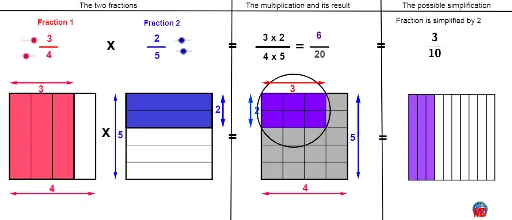
This example dynamically demonstrates the geometric meaning of fraction multiplication, showing that the product of two fractions equals the area of the resulting parallelogram. It involves core math concepts like fraction multiplication, similar triangles, parallelograms, equations, hypothesis testing, and congruence. Construction highlights include GeoGebra commands such as OrthogonalLine, Circle, Intersect, Polygon, Ray, Point, Vector, Translate, Segment, Line, Mirror, Midpoint, GCD, Sequence, Element, and Text. Suitable for middle school and above students learning fraction multiplication and its geometric applications, or for mathematical exploration activities.
GeoGebra Commands & Parameters
OrthogonalLine(A, yAxis) → eOrthogonalLine(A, e) → fCircle(A, Taille) → hIntersect(h, e, 1) → BIntersect(h, f, 2) → CIntersect(h, e, 1) → DOrthogonalLine(B, e) → iIntersect(h, f, 2) → EOrthogonalLine(C, f) → jIntersect(i, j) → FPolygon(A, B, F, C) → P, a_1, b_1, f_1, c_1Circle(A, VarRayon) → kIntersect(k, a_1) → G,Circle(G, A) → pIntersect(p, a_1, 2) → HCircle(H, G) → qIntersect(q, a_1) → I, JCircle(J, H) → rIntersect(r, a_1) → K, LCircle(L, J) → sIntersect(s, a_1) → M, NCircle(N, L) → tIntersect(t, a_1) → O, QCircle(Q, N) → d_1Intersect(d_1, a_1) → R, SCircle(S, Q) → e_1Intersect(e_1, a_1) → T, UCircle(U, S) → g_1Intersect(g_1, a_1) → V, WCircle(W, U) → h_1OrthogonalLine(G, a_1) → lOrthogonalLine(H, a_1) → mOrthogonalLine(J, a_1) → nOrthogonalLine(L, a_1) → i_1OrthogonalLine(N, a_1) → j_1OrthogonalLine(Q, a_1) → k_1OrthogonalLine(S, a_1) → l_1OrthogonalLine(U, a_1) → m_1OrthogonalLine(W, a_1) → n_1Intersect(f_1, l) → YIntersect(f_1, m) → ZIntersect(f_1, n) → A_1Intersect(f_1, i_1) → B_1Intersect(f_1, j_1) → C_1Intersect(f_1, k_1) → D_1Intersect(l_1, f_1) → E_1Intersect(f_1, m_1) → F_1Intersect(f_1, n_1) → G_1Ray(A, B) → p_1Point(p_1) → H_1Vector(A, H_1) → uTranslate(A, u) → A'Translate(B, u) → B'Translate(F, u) → F'Translate(C, u) → C'Polygon(A', B', F', C') → P', a', b', f', c'OrthogonalLine(V, a_1) → q_1Circle(V, U) → r_1Segment(G, Y) → s_1Segment(H, Z) → t_1Segment(J, A_1) → a_2Segment(L, B_1) → b_2Segment(N, C_1) → c_2Segment(Q, D_1) → d_2Segment(S, E_1) → e_2Segment(U, F_1) → f_2Segment(W, G_1) → g_2Circle(H_1, VarRayon_2) → h_2Intersect(h_2, c', 1) → J_1Circle(J_1, H_1) → k_2Intersect(k_2, c', 2) → K_1Circle(K_1, J_1) → p_2Intersect(p_2, c', 2) → L_1Circle(L_1, K_1) → q_2Intersect(q_2, c', 2) → M_1Circle(M_1, L_1) → r_2Intersect(r_2, c', 2) → N_1Circle(N_1, M_1) → s_2Intersect(s_2, c') → O_1, P_1Circle(P_1, N_1) → t_2Intersect(t_2, c', 2) → Q_1Circle(Q_1, P_1) → c_3Intersect(c_3, c', 2) → R_1Circle(R_1, Q_1) → d_3Intersect(d_3, c', 2) → S_1Circle(S_1, R_1) → e_3OrthogonalLine(J_1, c') → i_2OrthogonalLine(K_1, c') → j_2OrthogonalLine(L_1, c') → l_2OrthogonalLine(M_1, c') → m_2OrthogonalLine(N_1, c') → n_2OrthogonalLine(P_1, c') → a_3OrthogonalLine(Q_1, c') → b_3OrthogonalLine(R_1, c') → f_3OrthogonalLine(S_1, c') → g_3Intersect(b', i_2) → T_1Intersect(b', j_2) → U_1Intersect(b', l_2) → V_1Intersect(b', m_2) → W_1Intersect(b', n_2) → Y_1Intersect(b', a_3) → Z_1Intersect(b', b_3) → A_2Intersect(b', f_3) → B_2Intersect(b', g_3) → C_2Segment(J_1, T_1) → h_3Segment(U_1, K_1) → i_3Segment(L_1, V_1) → j_3Segment(W_1, M_1) → k_3Segment(N_1, Y_1) → l_3Segment(Z_1, P_1) → m_3Segment(Q_1, A_2) → n_3Segment(B_2, R_1) → p_3Segment(S_1, C_2) → q_3Circle(A, largeur_1) → r_3Intersect(r_3, a_1) → D_2, S_2OrthogonalLine(D_2, f_1) → s_3Intersect(s_3, f_1) → E_2OrthogonalLine(E_2, s_3) → t_3Intersect(t_3, c_1) → F_2Polygon(A, D_2, E_2, F_2) → P_2, a_4, d_4, e_4, f_4OrthogonalLine(O, a_1) → b_4Intersect(b_4, f_1) → G_2Circle(O, N) → g_4Circle(O_1, N_1) → q_4OrthogonalLine(O_1, c') → t_4Circle(H_1, Largeur_2) → h_5Intersect(h_5, c') → F_3, B1OrthogonalLine(F_3, c') → i_5Intersect(i_5, b') → G_3Polygon(H_1, F_3, G_3, B') → P_3, h_6, f_6, g_6, b'_1Line(A, H_1) → aPoint(a) → A1Line(A1, yAxis) → bMirror(A', b) → A''Mirror(B', b) → B''Mirror(F', b) → F''Mirror(C', b) → C''Polygon(A'', B'', F'', C'') → P'', a'', b'', f'', c''Mirror(H_1, b) → H_1'Mirror(F_3, b) → F_3'Mirror(G_3, b) → G_3'Mirror(B', b) → B''_1Polygon(H_1', F_3', G_3', B''_1) → P_3', h_1', f_3', g_3', b''_1Mirror(J_1, b) → J_1'Mirror(T_1, b) → T_1'Segment(J_1', T_1') → cMirror(U_1, b) → U_1'Mirror(K_1, b) → K_1'Segment(U_1', K_1') → dMirror(L_1, b) → L_1'Mirror(V_1, b) → V_1'Segment(L_1', V_1') → gMirror(W_1, b) → W_1'Mirror(M_1, b) → M_1'Segment(W_1', M_1') → a1Mirror(N_1, b) → N_1'Mirror(Y_1, b) → Y_1'Segment(N_1', Y_1') → b1Mirror(Z_1, b) → Z_1'Mirror(P_1, b) → P_1'Segment(Z_1', P_1') → c1Mirror(Q_1, b) → Q_1'Mirror(A_2, b) → A_2'Segment(Q_1', A_2') → d1Mirror(B_2, b) → B_2'Mirror(R_1, b) → R_1'Segment(B_2', R_1') → e1Mirror(S_1, b) → S_1'Mirror(C_2, b) → C_2'Segment(S_1', C_2') → f1Vector(A, B'') → vTranslate(A, v) → A'_1Translate(D_2, v) → D_2'Translate(E_2, v) → E_2'Translate(F_2, v) → F_2'Polygon(A'_1, D_2', E_2', F_2') → P_2', a'_1, d_2', e_2', f_2'Translate(G, v) → G'Translate(Y, v) → Y'Segment(G', Y') → g1Translate(H, v) → H'Translate(Z, v) → Z'Segment(H', Z') → h1Translate(J, v) → J'Translate(A_1, v) → A_1'Segment(J', A_1') → i1Translate(L, v) → L'Translate(B_1, v) → B_1'Segment(L', B_1') → j1Translate(N, v) → N'Translate(C_1, v) → C_1'Segment(N', C_1') → k1Translate(Q, v) → Q'Translate(D_1, v) → D_1'Segment(Q', D_1') → l1Translate(S, v) → S'Translate(E_1, v) → E_1'Segment(S', E_1') → m1Translate(U, v) → U'Translate(F_1, v) → F_1'Segment(U', F_1') → n1Translate(W, v) → W'Translate(G_1, v) → G_1'Segment(W', G_1') → p1Midpoint(f_1) → C1Midpoint(g_6) → E1Midpoint(c') → D1Midpoint(f'') → F1Midpoint(c'') → G1Midpoint(a_4) → H1Midpoint(a'_1) → I1Midpoint(g_3') → J1Circle(D1, 1.5) → q1Circle(C1, 2) → r1Circle(F1, 2) → s1Circle(G1, 1.5) → t1Line(C1, b) → a2Intersect(r1, a2) → K1, L1Line(L1, f_1) → b2Intersect(s1, b2) → M1, N1Line(F_2', b) → c2Line(C'', b) → d2Line(F, b) → e2Line(C, b) → f2Intersect(e2, b2) → O1Intersect(e2, f2) → P1Intersect(b2, f2) → Q1Vector(L1, O1) → wVector(L1, Q1) → zLine(D_2, b) → g2Circle(H1, 1.5) → h2Line(H1, b) → i2Intersect(h2, i2) → R1, S1Line(R1, v) → j2Intersect(g2, j2) → U1Intersect(f2, j2) → V1Circle(I1, 1.5) → k2Intersect(k2, j2) → W1, Z1Line(D_2', b) → l2Intersect(l2, j2) → A2Intersect(c2, j2) → B2Intersect(b2, c2) → C2Intersect(b2, d2) → D2Vector(R1, U1) → u1Vector(R1, V1) → v1Vector(W1, A2) → w1Vector(W1, B2) → z1Vector(M1, C2) → u2Vector(M1, D2) → v2Line(F, C') → m2Line(D1, j2) → n2Intersect(q1, n2) → E2, F2Line(E2, b) → p2Intersect(p2, m2) → G2Line(H_1, B) → q2Intersect(q2, p2) → H2Vector(E2, H2) → w2Vector(E2, G2) → z2Line(G_3, j2) → r2Circle(E1, 1.5) → s2Circle(J1, 1.5) → t2Intersect(t1, n2) → I2, J2Line(J2, b) → a3Intersect(q2, a3) → K2Intersect(m2, a3) → L2Vector(J2, K2) → u3Vector(J2, L2) → v3Line(J1, j2) → b3Intersect(t2, b3) → M2, N2Line(M2, b) → c3Intersect(c3, q2) → O2Intersect(r2, c3) → P2Vector(M2, O2) → w3Vector(M2, P2) → z3Intersect(s2, b3) → Q2, R2Line(R2, b) → d3Intersect(d3, q2) → S2Intersect(r2, d3) → U2Vector(R2, S2) → e3Vector(R2, U2) → f3Line(V2, xAxis) → g3Point(g3) → Z2Point(g3) → A3Point(g3) → B3Point(g3) → C3Point(g3) → D3Point(g3) → E3Segment(Z2, A3) → h3Segment(B3, C3) → i3Line(W2, h_6) → k3Line(F3, k3) → l3Point(g3) → G3Point(g3) → H3Point(g3) → I3Point(g3) → J3Segment(G3, H3) → j3Segment(I3, J3) → m3Intersect(c2, e) → M3Intersect(e, l2) → L3Line(P2, j2) → n3Intersect(c2, n3) → K3Midpoint(K3, L3) → N3Circle(N3, L3) → p3Intersect(p3, l2) → O3, P3Polygon(M3, L3, P3, K3) → poly1, m3_1, l3_1, p3_1, k3_1GCD((Num1 * Num2), (Den1 * Den2)) → qqVector(F'', I_1) → u_1Translate(A'', u_1) → A'''Translate(B'', u_1) → B'''Translate(F'', u_1) → F'''Translate(C'', u_1) → C'''Polygon(A''', B''', F''', C''') → P''', a''', b''', f''', c'''Sequence(Translate[I_1, Vector[(i * Vector[I_1, C'''])]], i, 0, 1, 1 / ((Den1 * Den2 / qq))) → liste1Sequence(Translate[B''', Vector[(i * Vector[I_1, C'''])]], i, 0, 1, 1 / ((Den1 * Den2 / qq))) → liste2Sequence(Segment[Element[liste1, i], Element[liste2, i]], i, 1, Length[liste1]) → liste3Element(liste1, 1 + (Num1 * Num2 / qq)) → RRElement(liste2, 1 + (Num1 * Num2 / qq)) → H_2Polygon(B''', H_2, RR, I_1) → poly2, b'''_1, h_4, rr, i_4Line(K_2, L_2) → c_4Line(M_2, N_2) → j_4Line(O_2, Q_2) → k_4Text(If[qq ≠ 1, "Fraction is simplified by " + ((qq * "")), "impossible to simplified"]) → texte6
AI Drawing Prompt Reference
Draw a dynamic geometric demonstration of fraction multiplication showing that the product of two fractions equals the area of the resulting parallelogram. Include a point, two perpendicular lines, a circle, and multiple intersection points to form a parallelogram and similar triangles, utilizing vector, polygon, and reflection concepts to create a clear geometric model that visually demonstrates the geometric meaning of fraction multiplication.
The prompt above was compiled from the original drawing commands and is for reference only.