
Fraction Division Demonstration by Ibrahim El Hage (2)
Loading the math board and drawing, please wait…
In collections
Fractions الكسور
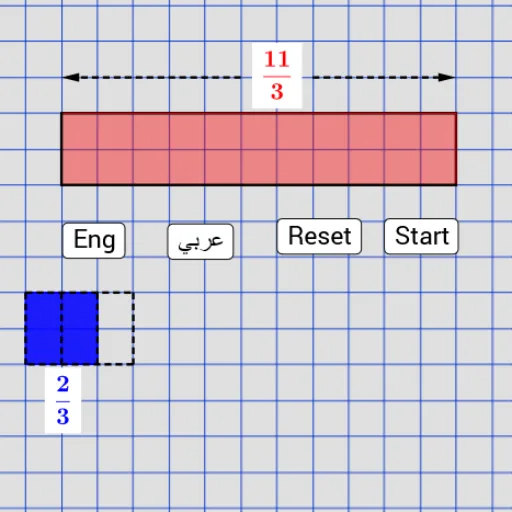
This example dynamically demonstrates the geometric meaning of fraction division, visually showing the inverse relationship between fraction division and multiplication. It involves core mathematical concepts such as fraction operations, geometric partitioning and combination, and vector operations. The construction utilizes GeoGebra commands like Polygon, Translate, Segment, and Vector, interacting to visualize fraction division. Suitable for middle school and above learners as an auxiliary tool for teaching fraction division, helping to understand abstract mathematical concepts.
GeoGebra Commands & Parameters
Polygon(A, E, F, D) → poly1, a, e, f, dTranslate(A, Vector[(b * Vector[A, G])]) → A'Translate(E, Vector[(b * Vector[A, G])]) → E'Translate(F, Vector[(b * Vector[A, G])]) → F'Translate(D, Vector[(b * Vector[A, G])]) → D'Polygon(A', E', F', D') → poly1', a', e', f', d'Translate(A, Vector[(b * Vector[A, H])]) → A'_1Translate(E, Vector[(b * Vector[A, H])]) → E'_1Translate(F, Vector[(b * Vector[A, H])]) → F'_1Translate(D, Vector[(b * Vector[A, H])]) → D'_1Polygon(A'_1, E'_1, F'_1, D'_1) → poly1'_1, a'_1, e'_1, f'_1, d'_1Translate(A, Vector[(b * Vector[A, I])]) → A'_2Translate(E, Vector[(b * Vector[A, I])]) → E'_2Translate(F, Vector[(b * Vector[A, I])]) → F'_2Translate(D, Vector[(b * Vector[A, I])]) → D'_2Polygon(A'_2, E'_2, F'_2, D'_2) → poly1'_2, a'_2, e'_2, f'_2, d'_2Translate(A, Vector[(b * Vector[A, J])]) → A'_3Translate(E, Vector[(b * Vector[A, J])]) → E'_3Translate(F, Vector[(b * Vector[A, J])]) → F'_3Translate(D, Vector[(b * Vector[A, J])]) → D'_3Polygon(A'_3, E'_3, F'_3, D'_3) → poly1'_3, a'_3, e'_3, f'_3, d'_3Translate(A, Vector[(b * Vector[A, K])]) → A'_4Translate(E, Vector[(b * Vector[A, K])]) → E'_4Translate(F, Vector[(b * Vector[A, K])]) → F'_4Translate(D, Vector[(b * Vector[A, K])]) → D'_4Polygon(A'_4, E'_4, F'_4, D'_4) → poly1'_4, a'_4, e'_4, f'_4, d'_4Translate(A, Vector[(b * Vector[A, L])]) → A'_5Translate(E, Vector[(b * Vector[A, L])]) → E'_5Translate(F, Vector[(b * Vector[A, L])]) → F'_5Translate(D, Vector[(b * Vector[A, L])]) → D'_5Polygon(A'_5, E'_5, F'_5, D'_5) → poly1'_5, a'_5, e'_5, f'_5, d'_5Segment(G, N) → pSegment(N, O) → qPolygon(G, N, O, (2, 9)) → poly2, t, f_1, g_1, h_1Segment(O, V) → rSegment(V, G) → sVector(P, Q) → uVector(R, S) → vSegment(A, B) → gSegment(B, C) → hSegment(C, D) → iSegment(A, D) → jSegment(T, U) → i_1Segment(E, F) → j_1
AI Drawing Prompt Reference
Draw a geometric demonstration of fraction division. Start with a quadrilateral as a unit rectangle, then replicate it horizontally multiple times at equal intervals to form a row of identical rectangles. Inside each rectangle, use segments to divide it into equal parts representing fractional units. Above or beside the row, add arrow vectors to indicate translation direction and scaling factor, visually showing the inverse relationship between division and multiplication. Use distinct colors for the original shape, translated copies, and vectors to clarify the geometric meaning of fraction operations.
The prompt above was compiled from the original drawing commands and is for reference only.