
Four Color Challenge
Loading the math board and drawing, please wait…
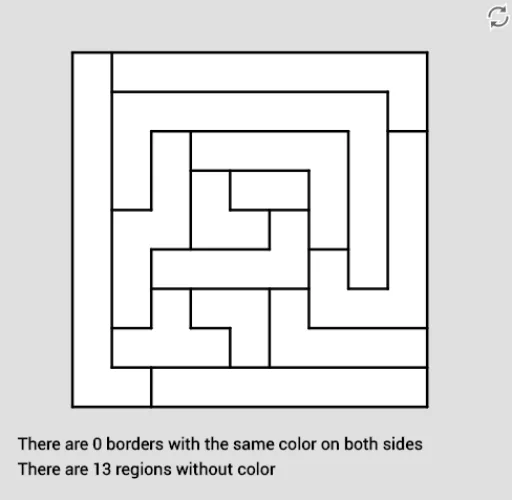
This example demonstrates the Four Color Theorem by allowing users to color a map using four colors (Blue, Green, Red, Purple) such that no two adjacent regions share the same color. It involves core math concepts in graph theory. Constructed using GeoGebra commands like Segment, Polygon, Sum, CountIf, and objects such as n, cB, cG, cR. Suitable for high school mathematics or computer science education on graph theory and algorithm design.
GeoGebra Commands & Parameters
Segment(A, C) → l_4Segment(C, Q_1) → k_5Segment(Q_1, O_1) → l_5Segment(O_1, A) → m_5Segment(B, E) → n_5Segment(D, H) → p_5Segment(D, P_1) → q_5Segment(I, J) → r_5Segment(J, U) → s_5Segment(O, R) → t_5Segment(P, K) → a_5Segment(K, L) → b_5Segment(L, F) → c_5Segment(Q, G) → d_5Segment(M, N) → f_6Segment(Z, A_1) → g_6Segment(A_1, H_1) → h_6Segment(H_1, J_1) → i_6Segment(I_1, V) → j_6Segment(U, W) → k_6Segment(W, C_1) → l_6Segment(B_1, D_1) → m_6Segment(F_1, B_1) → n_6Segment(E_1, G_1) → p_6Segment(G_1, M) → e_5Segment(X, Y) → q_6Segment(J_1, S) → r_6Segment(S, T) → s_6Segment(T, N_1) → t_6Segment(K_1, L_1) → a_6Segment(M_1, N_1) → b_6Polygon(B_1, D_1, G_1, F_1) → polígono1, b_7, d_6, g_7, f_7Polygon(V, W, C_1, B_1, F_1, E_1) → polígono2, v_3, w_3, c_6, b_8, f_8, e_6Polygon(O, R, D_1, C_1, W, U) → polígono3, o_3, r_7, d_7, c_7, w_4, u_3Polygon(X, Y, J_1, I_1, E_1, G_1) → polígono4, a_2, r_9, j_7, i_7, e_7, g_8Polygon(I, J, U, V, I_1, H_1, A_1, Z) → polígono5, i_8, j_8, u_4, v_4, i_9, h_7, a_7, z_4Polygon(D, F, L, K, P, O, J, I) → polígono6, d_8, f_9, l_7, k_7, p_7, o_4, j_9, i_{10}Polygon(F, G, Q, P, K, L) → polígono7, f_{10}, g_9, q_7, p_8, k_8, l_8Polygon(G, H, N, M, R, Q) → polígono8, g_{10}, h_8, n_7, m_7, r_8, q_8Polygon(M, N, L_1, K_1, T, S, Y, X) → polígono9, m_8, n_8, l_9, k_9, t_7, s_7, s_9, t_9Polygon(S, T, N_1, M_1, Z, A_1, H_1, J_1) → polígono10, s_8, t_8, n_9, m_9, z_5, a_8, h_9, j_{10}Polygon(K_1, L_1, Q_1, P_1, M_1, N_1) → polígono11, k_{10}, l_{10}, q_9, p_9, m_{10}, n_{10}Polygon(A, B, E, D, P_1, O_1) → polígono12, a_9, b_9, e_8, d_9, p_{10}, o_5Polygon(B, C, H, E) → polígono13, b_{10}, c_8, h_{10}, e_9Sum(frontera) → fmCountIf(ip ≟ 0, ip, pais) → pb
AI Drawing Prompt Reference
Draw a map with 12 regions, each filled with one of four colors: blue, green, red, or purple, ensuring no two adjacent regions have the same color. Start by drawing the boundary lines, then fill in the colors.
The prompt above was compiled from the original drawing commands and is for reference only.