
Folding Box Maximum Volume - Dynamic Simulation and Extreme Value
Loading the math board and drawing, please wait…
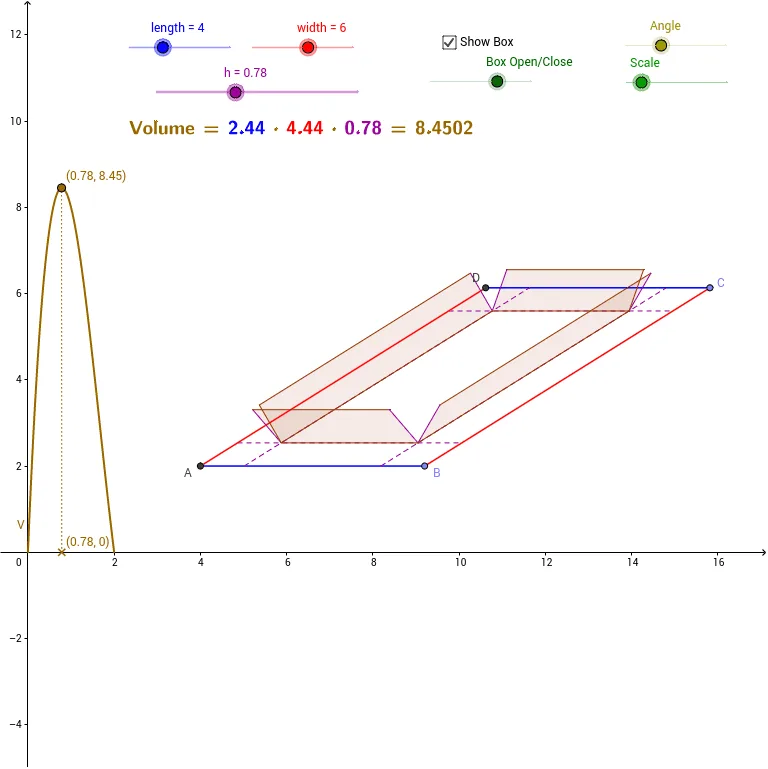
① This GeoGebra example dynamically simulates the process of cutting equal squares from the corners of a rectangular sheet and folding it into an open-top box, visually showing how the box volume changes with the cut size and automatically locating the maximum volume point. ② Core mathematical concepts include function modeling, derivative-based optimization, cubic functions, volume formulas, and extreme value problems, integrating algebra with solid geometry. ③ Construction highlights: the Function command defines the volume function V(h), Segment, Rotate, and Polygon build the 3D folded box model, Derivative computes the derivative, Root and Min locate critical points, sliders allow dynamic parameter adjustment, and Angle, Intersect support auxiliary geometric constructions. ④ Suitable for high school or early college students to understand the practical application of derivatives in optimization, and useful as a classroom demonstration for mathematical modeling or inquiry-based learning, bridging abstract extreme value concepts with interactive visualization.
GeoGebra Commands & Parameters
Function(x * (length - 2 * x) * (width - 2 * x), 0, Vright) → VSegment(B, C) → bRotate(B, α, A) → B'Line(B', A) → sLine(Ax, s) → s1Segment(A, B) → aLine(C, a) → rIntersect(s, r) → DLine(Dy, r) → r1Intersect(r1, b) → CySegment(Dy, Cy) → c1Segment(C, D) → cIntersect(s1, c) → DxSegment(Ax, Dx) → d1Intersect(d1, c1) → D1Line(B, s) → qLine(Bx, q) → q1Intersect(q1, c) → CxSegment(Bx, Cx) → b1Intersect(b1, c1) → C1Line(A, B) → pLine(Ay, p) → p1Intersect(p1, b) → BySegment(Ay, By) → a1Intersect(d1, a1) → A1Intersect(b1, a1) → B1Angle(B, A, B') → βSegment(D, A) → dPolygon(A1, A2a, B2a, B1) → poly1, e, f, g, h_1Polygon(B1, B2b, C2b, C1) → poly2, i, j, k, lPolygon(C1, C2c, D2c, D1) → poly3, c_1, d_1, e_1, f_1Polygon(D1, D2d, A2d, A1) → poly4, m, n, a_1, b_1Derivative(V) → VderRoot(Vder) → tMax_1, tMax_2Min(x(tMax_1), x(tMax_2)) → tMaxSegment(tMax_1, P) → g_1
AI Drawing Prompt Reference
Draw a rectangular sheet and cut equal squares from each corner. Fold it into an open-top box and use a slider to adjust the size of the squares, observing how the box volume changes. Draw the 3D model of the box, including the base and four sides. Use a function to represent the volume and find the maximum volume by differentiation.
The prompt above was compiled from the original drawing commands and is for reference only.