
Finding Equivalent Fractions
Loading the math board and drawing, please wait…
In collections
Bruchzahlen: Erweitern und Kürzen
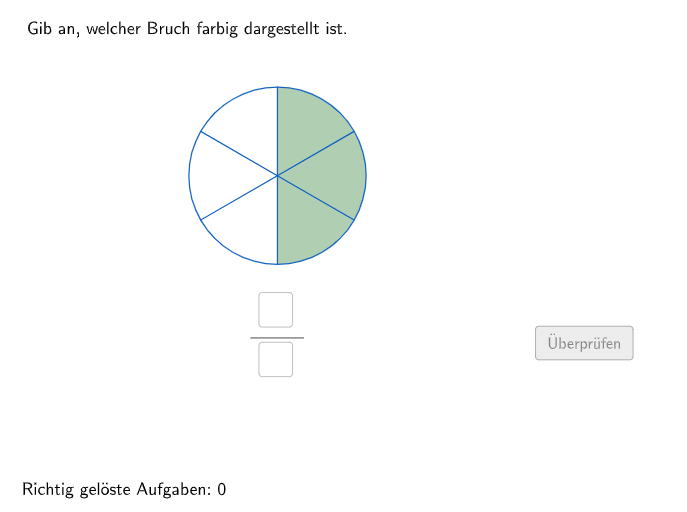
This GeoGebra example demonstrates how to find equivalent fractions for two given fractions. The core math concepts involved are fraction comparison and simplification. The construction points include using GeoGebra's Sequence, If, and Join commands to create a graphical representation of fractions. This example is suitable for 5-6 grade students, helping them understand and manipulate fraction concepts.
GeoGebra Commands & Parameters
Sequence(Random[2, 12], i, 1, 100) → randomNosNenner, {12, 6, 8, 6, 4, 4, 11, 5, 2, 2, 2, 9, 6, 6, 10, 7, 10, 10, 11, 7, 10, 8, 10, 7, 7, 12, 12, 2, 2, 3, 6, 3, 12, 8, 9, 3, 11, 2, 12, 12, 5, 5, 4, 12, 3, 11, 3, 11, 2, 10, 11, 7, 11, 10, 10, 4, 9, 3, 11, 5, 4, 2, 7, 7, 4, 2, 9, 6, 10, 5, 9, 2, 9, 5, 7, 12, 2, 2, 7, 7, 8, 8, 11, 2, 2, 2, 7, 9, 8, 7, 6, 2, 5, 9, 5, 10, 3, 11, 3, 6}Sequence(Random[1, nenner2 - 1], i, 1, 100) → randomNosZaehler, {2, 3, 1, 1, 3, 3, 2, 1, 2, 4, 3, 3, 3, 5, 1, 1, 2, 3, 2, 1, 4, 5, 2, 1, 5, 1, 3, 3, 4, 2, 2, 3, 4, 4, 3, 3, 5, 5, 3, 2, 5, 2, 3, 2, 3, 5, 5, 2, 2, 3, 2, 5, 5, 5, 5, 4, 2, 1, 3, 5, 1, 4, 1, 2, 3, 2, 5, 1, 3, 5, 3, 1, 1, 2, 1, 2, 1, 1, 3, 5, 3, 1, 3, 3, 1, 3, 5, 5, 1, 4, 3, 1, 3, 2, 2, 5, 2, 1, 5, 2}If(randomNosZaehler(questionCount) ≟ 0, 1, randomNosZaehler(questionCount)) → zaehler2Join({{0.25, 0.5}, Intersection[DivisorsList[nenner2], DivisorsList[zaehler2]]}) → durchschnittTeilerIf(¬part2, Pos1, Pos2) → MidPointCircle(MidPoint, pointKreis1) → kreis1Join({{"$\textsf{\vphantom{Äg}\phantom{=}}$"}, Sequence[(("$\textsf{\vphantom{Äg}" * AufgabenText(i)) * "}$"), i, 1, CountIf[x ≠ "" ∨ x ≠ 0, AufgabenText]]}) → LDP1CountIf(x ≠ 0, durchschnittTeiler) → anzahlTeilerIf(¬part2, correct1 ∧ correct2, correct3 ∧ correct4) → correctIf(¬recSplit, (x(pointAreaLeft2), y(pointAreaLeft4)), pointAreaLeft4 + (((If[zaehler2 > nenner2 / 2, zaehler2 - nenner2 / 2, zaehler2] * 2) * dxRectangle / nenner2), 0)) → pointAreaLeft3Sequence(Random[2, 12], i, 1, 100) → randomNenner, {5, 8, 11, 12, 2, 12, 7, 3, 11, 8, 7, 11, 2, 9, 12, 11, 4, 2, 2, 6, 2, 12, 7, 5, 12, 9, 7, 5, 5, 9, 7, 2, 5, 4, 4, 11, 10, 7, 11, 6, 8, 11, 11, 5, 11, 6, 6, 10, 11, 9, 2, 3, 8, 10, 2, 10, 3, 10, 5, 9, 2, 10, 12, 7, 12, 6, 4, 6, 2, 6, 10, 4, 6, 10, 9, 8, 2, 2, 6, 4, 10, 8, 3, 4, 5, 11, 9, 5, 3, 2, 8, 7, 12, 12, 2, 10, 9, 5, 10, 7}Sequence(Random[2, nenner2 - 1], i, 1, 100) → randomZaehler, {2, 2, 4, 4, 5, 2, 2, 5, 4, 2, 4, 2, 3, 5, 4, 5, 5, 4, 5, 2, 5, 2, 2, 5, 5, 5, 2, 3, 3, 3, 3, 3, 2, 5, 4, 4, 3, 5, 3, 5, 5, 4, 5, 2, 3, 5, 5, 5, 2, 5, 2, 2, 5, 2, 5, 3, 2, 4, 5, 3, 5, 5, 3, 3, 5, 5, 2, 4, 4, 4, 3, 4, 2, 2, 2, 3, 5, 3, 4, 4, 2, 5, 3, 5, 4, 2, 3, 2, 3, 4, 5, 4, 2, 2, 4, 4, 3, 2, 4, 4}Sequence(I + ((i * widthNennerBar / 12) * (1, 0)), i, 1, 12) → allowedPositionsNennerBarPoint(allowedPositionsNennerBar) → PNennerCircle(M, B) → cSegment(M, M + (Radius[c] * (0, 1))) → fVector(F, G) → uSegment(H, H + (widthZaehlerBar * (1, 0))) → gSegment(I, I + (widthNennerBar * (1, 0))) → hSequence(H + ((i * widthZaehlerBar / 12) * (1, 0)), i, 0, nenner2) → allowedPositionsZaehlerBarPoint(allowedPositionsZaehlerBar) → PZaehlerSequence(Rotate[f, ((i * 2) * pi / nenner2), M], i, 0, nenner2 - 1) → listAreaLeft_{1}Sequence(CircleSector[MidPoint, Rotate[KreisOben, (((-(i + 1)) * 2) * pi / nenner2), MidPoint], Rotate[KreisOben, (((-i) * 2) * pi / nenner2) - 0.0001, MidPoint]], i, 0, zaehler2 - 1) → listAreaLeftCircleSequence(Random[1, zaehler2 - 1], i, 1, 100) → randomSubtrahend, {1, 1, 2, 1, 1, 2, 2, 2, 2, 2, 2, 2, 1, 1, 2, 2, 2, 2, 1, 1, 2, 1, 1, 2, 1, 2, 2, 1, 2, 1, 2, 2, 2, 1, 1, 1, 2, 1, 1, 1, 1, 2, 1, 2, 1, 2, 1, 1, 2, 1, 2, 1, 2, 1, 2, 2, 2, 1, 2, 2, 2, 2, 2, 2, 1, 1, 1, 1, 1, 2, 2, 1, 2, 1, 2, 1, 1, 1, 1, 1, 2, 2, 2, 2, 1, 2, 2, 1, 2, 2, 1, 1, 2, 1, 1, 1, 2, 2, 1, 2}Center(sektor12v1) → M12v1Center(sektor12v2) → M12v2Center(sektor12v3) → M12v3Center(sektor12v4) → M12v4Center(sektor12v5) → M12v5Center(sektor12v6) → M12v6Center(sektor12v7) → M12v7Center(sektor12v8) → M12v8Center(sektor12v9) → M12v9Center(sektor12v10) → M12v10Center(sektor12v11) → M12v11Center(sektor12v12) → M12v12Textfield(input1) → Eingabefeld1Textfield(input2) → Eingabefeld2Join({{"$\textsf{\vphantom{Äg}Wähle aus!}$"}, Sequence[(("$\textsf{\vphantom{Äg}" * AufgabenText(i)) * "}$"), i, 1, CountIf[x ≠ "" ∨ x ≠ 0, AufgabenText]]}) → LDP1_{1}Join({{"$\textsf{\vphantom{Äg}Wähle aus!}$"}, Sequence[(("$\textsf{\vphantom{Äg}" * AufgabenText(i)) * "}$"), i, 1, CountIf[x ≠ "" ∨ x ≠ 0, AufgabenText]]}) → LDP2Point(xAxis) → JOrthogonalLine(J, xAxis) → iPoint(xAxis) → KLineBisector(K, J) → jTranslate({listAreaLeftCircle}, (dxBruch2, 0)) → showBruch201Sequence(Rotate[f, ((i * 2) * pi / ((verfeinerung * nenner2))), M], i, 0, (verfeinerung * nenner2) - 1) → l3Translate({l3}, (dxBruch2, 0)) → showBruch202Translate({c, listAreaLeft_{1}}, (dxBruch2, 0)) → showBruch203LaTeX(step, true, true) → Text5CircleArc(O, N, PosBogerl) → bogerl11Point(bogerl11) → pointBogerl1Vector(pointBogerl1, N + (0.1 * Vector[pointBogerl1, N])) → bogerl1pfeilOrthogonalLine(Q, yAxis) → kSequence(7) → listStepsMin(listSteps) → MinMax(listSteps) → MaximumSegment(pointFrame3, pointFrame2) → lineLeftHorizontalSegment(pointFrame2, pointFrame1) → lineLeftVerticalJoin({Sequence[Segment[Translate[pointFrame2, (i * If[nenner2 ≟ 2, (i * dxRectangle / nenner2), ((dxRectangle * If[Mod[nenner2, 2] ≟ 0, 2, 1] / nenner2), 0)])], Translate[pointFrame1, (i * If[nenner2 ≟ 2, (i * dxRectangle / nenner2), ((dxRectangle * If[Mod[nenner2, 2] ≟ 0, 2, 1] / nenner2), 0)])]], i, 0, (nenner2 * If[Mod[nenner2, 2] ≟ 0, 0.5, 1])], Sequence[Segment[Translate[pointFrame3, (i * If[Mod[nenner2, 2] ≟ 0 ∧ nenner2 ≠ 2, (0, dyRectangle / 2), (0, dyRectangle)])], Translate[pointFrame2, (i * If[Mod[nenner2, 2] ≟ 0 ∧ nenner2 ≠ 2, (0, dyRectangle / 2), (0, dyRectangle)])]], i, 0, If[Mod[nenner2, 2] ≟ 0 ∧ nenner2 ≠ 2, 2, 1]]}) → listLeftLinesVerticalJoin({{lineLeftHorizontal, lineLeftVertical}, {Segment[Translate[pointFrame3, (0, dyRectangle)], Translate[pointFrame2, (0, dyRectangle)]]}, {Segment[Translate[pointFrame2, (dxRectangle, 0)], Translate[pointFrame1, (dxRectangle, 0)]]}}) → listFrameLeftTranslate(listFrameLeft, (dxShift, 0)) → listFrameRightTranslate(listAreaLeft, (dxShift, 0)) → listAreaRightIntersection(DivisorsList[zaehler2], DivisorsList[nenner2]) → l1Join({Sequence[Translate[Segment[Translate[pointFrame2, (dxShift, 0)], Translate[pointFrame1, (dxShift, 0)]], (i * If[nenner3 ≟ 2, (i * dxRectangle / nenner3), ((dxRectangle * If[Mod[nenner3, 2] ≟ 0, 2, 1] / nenner3), 0)])], i, 0, (nenner3 * If[Mod[nenner3, 2] ≟ 0, 0.5, 1])], Sequence[Translate[Segment[Translate[pointFrame3, (dxShift, 0)], Translate[pointFrame2, (dxShift, 0)]], (i * If[Mod[nenner3, 2] ≟ 0 ∧ nenner3 ≠ 2, (0, dyRectangle / 2), (0, dyRectangle)])], i, 0, If[Mod[nenner3, 2] ≟ 0 ∧ nenner3 ≠ 2, 2, 1]]}) → l4If(¬recSplit2, (x(pointAreaRight2), y(pointAreaRight4)), pointAreaRight4 + (((If[zaehler3 > nenner3 / 2, zaehler3 - nenner3 / 2, zaehler3] * 2) * dxRectangle / nenner3), 0)) → pointAreaRight3OrthogonalLine(L, yAxis) → lMirror(bogerl11, l) → bogerl12Mirror(pointBogerl1, l) → pointBogerl2Sequence(Segment[Rotate[MidPoint, ((i * 2) * pi / nenner2), MidPoint], Rotate[pointKreis1, ((i * 2) * pi / nenner2), MidPoint]], i, 0, nenner2 - 1) → listLinesCircleLeft1Sequence(Segment[Rotate[MidPoint2, ((i * 2) * pi / nenner3), MidPoint2], Rotate[KreisOben2, ((i * 2) * pi / nenner3), MidPoint2]], i, 0, nenner3 - 1) → listLinesCircleRightCircle(MidPoint2, radius) → kreis2Sequence(CircleSector[MidPoint2, Rotate[KreisOben2, (((-(i + 1)) * 2) * pi / nenner3), MidPoint2], Rotate[KreisOben2, (((-i) * 2) * pi / nenner3) - 0.0001, MidPoint2]], i, 0, zaehler3 - 1) → listAreaRightCircleRotate(KreisOben, ((-zaehler2) * (360°) / nenner2), MidPoint) → KreisEckpunktCircleSector((-5.766287229319031, 3.8699043461027944), (-5.766287229319031, 1.5199043461027948), (-5.766287229319031, 6.219904346102794)) → listAreaLeftCircle2Textfield(input3) → Eingabefeld3Textfield(input4) → Eingabefeld4Textfield(input1) → zwEingabefeld1Textfield(input2) → zwEingabefeld2
AI Drawing Prompt Reference
Create a visual practice for finding equivalent fractions by comparing two given fractions. Show two fraction representations in the same scene: each fraction is displayed with a circular area divided into equal sectors from a fixed center, with a specific number of sectors highlighted to represent the numerator over the denominator. Place the two fraction diagrams next to each other so the highlighted sector areas can be compared, and emphasize the shared/overlapping part corresponding to common divisors of the two values. Include an instruction and a “choose” style text area with multiple selectable input blanks, plus a small region that supports checking the entered/selected answer.
The prompt above was compiled from the original drawing commands and is for reference only.