
Exponential Function Basics: Constructing Features via Intersections
Loading the math board and drawing, please wait…
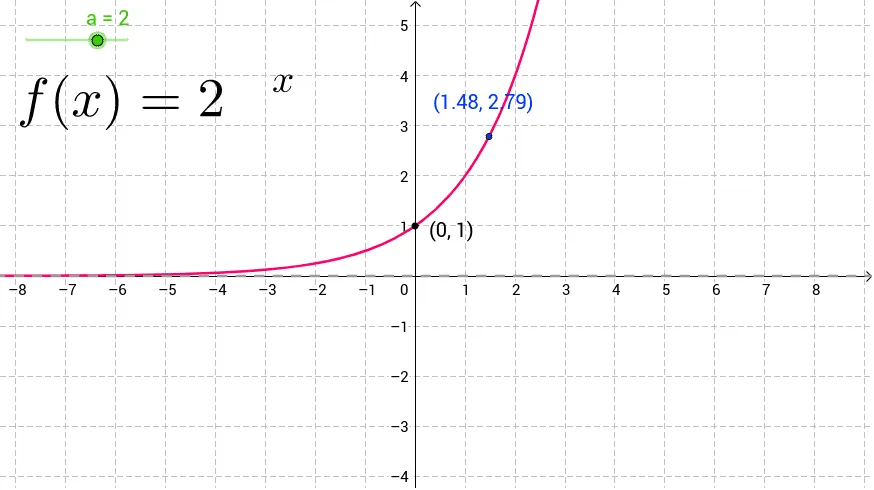
This example demonstrates fundamental behaviors of exponential functions by showing how, for selected parameters, the exponential curve intersects with constructed reference elements. The visual interaction between curves and geometric constructions helps convey growth/decay intuition and how specific values relate to points on the graph. Key concepts include exponential functions and their graphical characteristics, the correspondence between function behavior and visual intersections, and (by extension) intuitive links to inequalities and limits. Construction is built using GeoGebra commands derived from the provided summary: Point to define critical points (e.g., a, b, c, d) and Intersect to compute intersection points that determine the main features; additional objects such as f and labeled points A, B, C are used to anchor the depiction, while text1 and text2 provide annotations for parameters or takeaways. Suitable for late middle school through high school learning, as well as for teaching demonstrations focused on exponential graphs and function visualization.
GeoGebra Commands & Parameters
Point(f) → AIntersect(f, xAxis, (-7497.650764102542, 0)) → BIntersect(f, yAxis, (0, 1)) → C
AI Drawing Prompt Reference
Draw an exponential function graph on a coordinate plane. Mark three critical points: first place a reference point on the exponential curve to serve as a key anchor, then identify and mark the intersection between the curve and the x-axis, and finally identify and mark the intersection between the curve and the y-axis at y=1. Use these labeled intersection points to visually communicate the basic growth/decay behavior of exponential functions and how specific values correspond to the graph at the reference elements. Optionally add brief annotations about the parameter meaning and what the intersections suggest, emphasizing the curve’s intersection with the axes.
The prompt above was compiled from the original drawing commands and is for reference only.