
Exponent Problems Demo
Loading the math board and drawing, please wait…
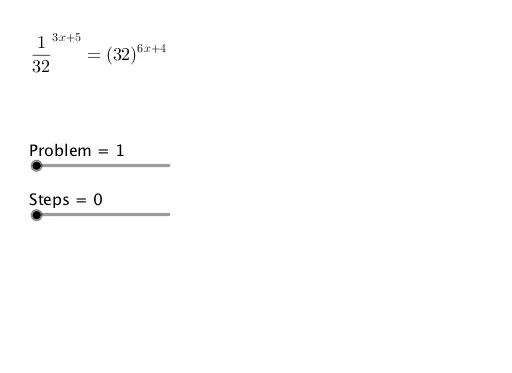
This example dynamically demonstrates exponent problems and their solutions using GeoGebra. It involves core math concepts like exponentiation, similarity transformation, arithmetic mean, real numbers, normal distribution, and cylinders. Construction highlights include commands RandomElement, If, Random, Element, and objects like A1-B15 for random base-exponent pairs. Suitable for high school mathematics teaching to illustrate exponent properties and probability statistics applications.
GeoGebra Commands & Parameters
RandomElement(Bases) → baseIf(base ≟ 2, 5, If[base ≟ 3, 4, 3]) → aRandomElement(Bases) → A1If(A1 ≟ 2, 5, If[A1 ≟ 3, 4, 3]) → B1RandomElement(Bases) → A2If(A2 ≟ 2, 5, If[A2 ≟ 3, 4, 3]) → B2RandomElement(Bases) → A3If(A3 ≟ 2, 5, If[A3 ≟ 3, 4, 3]) → B3RandomElement(Bases) → A4If(A4 ≟ 2, 5, If[A4 ≟ 3, 4, 3]) → B4RandomElement(Bases) → A5If(A5 ≟ 2, 5, If[A5 ≟ 3, 4, 3]) → B5RandomElement(Bases) → A6If(A6 ≟ 2, 5, If[A6 ≟ 3, 4, 3]) → B6RandomElement(Bases) → A7If(A7 ≟ 2, 5, If[A7 ≟ 3, 4, 3]) → B7RandomElement(Bases) → A8If(A8 ≟ 2, 5, If[A8 ≟ 3, 4, 3]) → B8RandomElement(Bases) → A9If(A9 ≟ 2, 5, If[A9 ≟ 3, 4, 3]) → B9RandomElement(Bases) → A10If(A10 ≟ 2, 5, If[A10 ≟ 3, 4, 3]) → B10RandomElement(Bases) → A11If(A11 ≟ 2, 5, If[A11 ≟ 3, 4, 3]) → B11RandomElement(Bases) → A12If(A12 ≟ 2, 5, If[A12 ≟ 3, 4, 3]) → B12RandomElement(Bases) → A13If(A13 ≟ 2, 5, If[A13 ≟ 3, 4, 3]) → B13RandomElement(Bases) → A14If(A14 ≟ 2, 5, If[A14 ≟ 3, 4, 3]) → B14RandomElement(Bases) → A15If(A15 ≟ 2, 5, If[A15 ≟ 3, 4, 3]) → B15Random(B1, (-B1)) → C1Random(B1, (-B1)) → D1Random(B2, (-B2)) → C2Random(B3, (-B3)) → C3Random(B4, (-B4)) → C4Random(B5, (-B5)) → C5Random(B6, (-B6)) → C6Random(B7, (-B7)) → C7Random(B8, (-B8)) → C8Random(B9, (-B9)) → C9Random(B10, (-B10)) → C10Random(B11, (-B11)) → C11Random(B12, (-B12)) → C12Random(B13, (-B13)) → C13Random(B14, (-B14)) → C14Random(B15, (-B15)) → C15Random(B2, (-B2)) → D2Random(B3, (-B3)) → D3Random(B4, (-B4)) → D4Random(B5, (-B5)) → D5Random(B6, (-B6)) → D6Random(B7, (-B7)) → D7Random(B8, (-B8)) → D8Random(B9, (-B9)) → D9Random(B10, (-B10)) → D10Random(B11, (-B11)) → D11Random(B12, (-B12)) → D12Random(B13, (-B13)) → D13Random(B14, (-B14)) → D14Random(B15, (-B15)) → D15RandomElement(Digits) → E1RandomElement(Digits) → F1RandomElement(Digits) → G1RandomElement(Digits) → H1RandomElement(Digits) → E2RandomElement(Digits) → F2RandomElement(Digits) → G2RandomElement(Digits) → H2RandomElement(Digits) → E3RandomElement(Digits) → F3RandomElement(Digits) → G3RandomElement(Digits) → H3RandomElement(Digits) → E4RandomElement(Digits) → F4RandomElement(Digits) → G4RandomElement(Digits) → H4RandomElement(Digits) → E5RandomElement(Digits) → F5RandomElement(Digits) → G5RandomElement(Digits) → H5RandomElement(Digits) → E6RandomElement(Digits) → F6RandomElement(Digits) → G6RandomElement(Digits) → H6RandomElement(Digits) → E7RandomElement(Digits) → F7RandomElement(Digits) → G7RandomElement(Digits) → H7RandomElement(Digits) → E8RandomElement(Digits) → F8RandomElement(Digits) → G8RandomElement(Digits) → H8RandomElement(Digits) → E9RandomElement(Digits) → F9RandomElement(Digits) → G9RandomElement(Digits) → H9RandomElement(Digits) → E10RandomElement(Digits) → F10RandomElement(Digits) → G10RandomElement(Digits) → H10RandomElement(Digits) → E11RandomElement(Digits) → F11RandomElement(Digits) → G11RandomElement(Digits) → H11RandomElement(Digits) → E12RandomElement(Digits) → F12RandomElement(Digits) → G12RandomElement(Digits) → H12RandomElement(Digits) → E13RandomElement(Digits) → F13RandomElement(Digits) → G13RandomElement(Digits) → H13RandomElement(Digits) → E14RandomElement(Digits) → F14RandomElement(Digits) → G14RandomElement(Digits) → H14RandomElement(Digits) → E15RandomElement(Digits) → F15RandomElement(Digits) → G15RandomElement(Digits) → H15Element(A1:A15, Problem) → base1Element(C1:C15, Problem) → exp1Element(D1:D15, Problem) → exp2Element(H1:H15, Problem) → co1Element(E1:E15, Problem) → co2Element(F1:F15, Problem) → con1Element(G1:G15, Problem) → con2
AI Drawing Prompt Reference
Demonstrate exponent problems dynamically with randomly generated base-exponent pairs, showing coordinate and solid geometry relationships, similarity transformations, and probability statistics applications, using different colors for calculation results to highlight exponent properties and the connection to normal distribution.
The prompt above was compiled from the original drawing commands and is for reference only.