
Exponent Number Facts: Random Points and Polygons Exploring Exponential Patterns
Loading the math board and drawing, please wait…
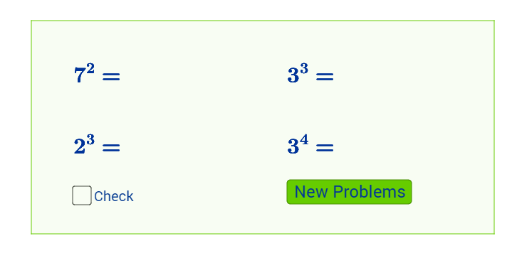
① This example dynamically demonstrates exponent number facts (such as squares and cubes) by generating random points and polygons, linking numerical exponential values with geometric representations. ② Core mathematical concepts include exponentiation (squares, cubes), number patterns, random number generation, and the correspondence between polygon properties (area/side length) and exponential values; it also touches on linear equations and differential equations as background themes. ③ Construction highlights: using GeoGebra commands Random, Point, and Polygon to create random points and polygons (e.g., poly1), with text objects (text1, text2, etc.) displaying computed exponent results; a button (button1) triggers random updates, while variables (a, b, c) control bases and exponents for interactive exploration. ④ Suitable for middle and high school mathematics (grades 7-12) as an introduction to exponential functions, ideal for math labs or inquiry-based learning, helping students connect abstract exponent operations with visual geometric patterns and develop number-sense and visualization skills.
GeoGebra Commands & Parameters
Random(1, 12) → aRandom(1, 10) → bRandom(1, 5) → cPoint(yAxis) → APoint(yAxis) → BPolygon(B, C, D, A) → poly1, b_1, c_1, d_1, a_1