
Exploring Triangle Relationships
Loading the math board and drawing, please wait…
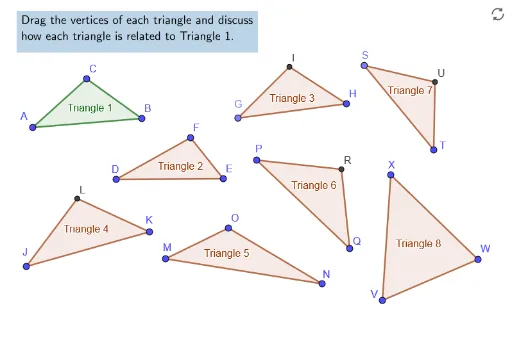
This example demonstrates dynamic exploration of relationships between triangles, circles, angles, and other geometric elements. Key math concepts include congruence, similar triangles, trigonometric functions, angle calculations, and optimization via differential calculus. Construction highlights GeoGebra commands like Polygon, Circle, Point, Intersect, and Ray. Suitable for high school and above, focusing on geometric transformations, function modeling, and optimization problems.
GeoGebra Commands & Parameters
Polygon(A, B, C) → t1, c, a, bCircle(D, Segment[A, B]) → dPoint(d) → ECircle(E, Segment[A, C]) → eCircle(D, Segment[B, C]) → fIntersect(e, f, 1) → FPolygon(D, E, F) → t2, f_1, d_1, e_1Circle(G, Segment[A, B]) → gPoint(g) → HCircle(H, Segment[A, C]) → hCircle(G, Segment[B, C]) → kIntersect(h, k, 1) → IPolygon(I, H, G) → t3, g_1, i, h_1Ray(J, K) → jPoint(c) → LCircle(A, L) → pIntersect(p, b, 1) → MPoint(c) → NCircle(B, N) → qIntersect(q, a, 1) → OCircle(J, Segment[A, L]) → rIntersect(r, j, 1) → PCircle(P, Segment[L, M]) → sIntersect(r, s, 1) → QRay(J, Q) → lCircle(K, Segment[B, N]) → tIntersect(t, j, 1) → RCircle(R, Segment[N, O]) → c_1Intersect(t, c_1, 2) → SRay(K, S) → mIntersect(l, m) → TPolygon(T, J, K) → t4, k_1, t_1, j_1Ray(U, V) → nPoint(c) → WCircle(A, W) → p_1Point(c) → ZCircle(B, Z) → q_1Intersect(p_1, b, 1) → A_1Intersect(q_1, a, 1) → B_1Circle(U, Segment[A, W]) → r_1Circle(V, Segment[B, Z]) → s_1Intersect(r_1, n, 1) → C_1Intersect(s_1, n, 1) → D_1Circle(C_1, Segment[W, A_1]) → c_2Circle(D_1, Segment[Z, B_1]) → d_2Intersect(r_1, c_2, 1) → E_1Intersect(s_1, d_2, 2) → F_1Ray(U, E_1) → i_1Ray(V, F_1) → l_1Intersect(i_1, l_1) → G_1Polygon(G_1, U, V) → t5, v, m_1, uPolygon(H_1, I_1, J_1) → t6, n_1, a_1, b_1Polygon(K_1, L_1, M_1) → t7, f_2, g_2, h_2Polygon(N_1, O_1, P_1) → t8, i_2, j_2, o_1
AI Drawing Prompt Reference
Draw a dynamic geometric diagram showing relationships between triangles, circles, and angles. Start by constructing two triangles and three circles, connecting them through intersection points. Add rays and more circles to form a complex structure. Finally, demonstrate similarity, congruence, and trigonometric functions through optimization and calculations.
The prompt above was compiled from the original drawing commands and is for reference only.