
Exploring Triangle Reflection
Loading the math board and drawing, please wait…
In collections
Reflections
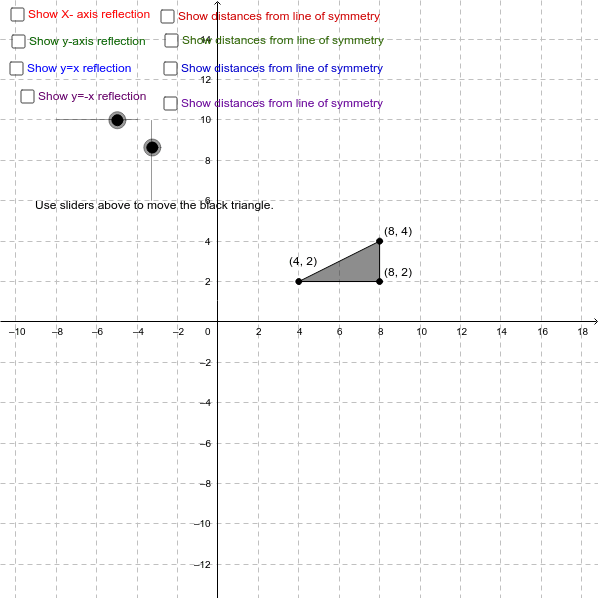
This example demonstrates the reflection transformation of a triangle across a line and its properties. Core math concepts include reflection symmetry, coordinate geometry, and geometric transformations. It utilizes commands like Polygon, Mirror, OrthogonalLine, Intersect, and Segment in GeoGebra for construction. Suitable for high school students learning geometric transformations and coordinate geometry.
GeoGebra Commands & Parameters
Polygon(A, B, C) → poly1, c_1, a_1, b_1Mirror(A, a) → A'Mirror(B, a) → B'Mirror(C, a) → C'Polygon(A', B', C') → poly1', c', a', b'Mirror(A, b) → A'_1Mirror(B, b) → B'_1Mirror(C, b) → C'_1Polygon(A'_1, B'_1, C'_1) → poly1R, c'_1, a'_1, b'_1Mirror(A, c) → A'_2Mirror(B, c) → B'_2Mirror(C, c) → C'_2Polygon(A'_2, B'_2, C'_2) → poly1G, c'_2, a'_2, b'_2Mirror(A, f) → A'_3Mirror(B, f) → B'_3Mirror(C, f) → C'_3Polygon(A'_3, B'_3, C'_3) → poly1'_1, c'_3, a'_3, b'_3OrthogonalLine(A, a) → kOrthogonalLine(C, a) → lOrthogonalLine(B, a) → mIntersect(a, k) → DSegment(A, D) → nSegment(A', D) → pIntersect(a, m) → ESegment(B, E) → qSegment(E, B') → rIntersect(a, l) → FSegment(C, F) → sSegment(F, C') → tOrthogonalLine(A, b) → d_1OrthogonalLine(B, b) → e_1OrthogonalLine(C, b) → f_1Intersect(b, e_1) → GSegment(B, G) → g_1Segment(C, G) → h_1Segment(G, B'_1) → i_1Segment(G, C'_1) → j_1Intersect(b, d_1) → HSegment(A'_1, H) → k_1Segment(A, H) → l_1OrthogonalLine(A, c) → m_1OrthogonalLine(C, c) → n_1Intersect(c, m_1) → ISegment(A, I) → p_1Segment(B, I) → q_1Intersect(c, n_1) → JSegment(C, J) → r_1Segment(I, A'_2) → s_1Segment(I, B'_2) → t_1Segment(J, C'_2) → a_2OrthogonalLine(A, f) → b_2OrthogonalLine(B, f) → c_2OrthogonalLine(C, f) → d_2Intersect(f, b_2) → KSegment(A, K) → e_2Intersect(f, c_2) → LSegment(B, L) → f_2Intersect(f, d_2) → MSegment(C, M) → g_2Segment(K, A'_3) → h_2Segment(M, C'_3) → i_2Segment(L, B'_3) → j_2
AI Drawing Prompt Reference
Draw a triangle and a line, reflect the triangle across the line to create three new triangles, then draw the perpendicular bisectors of the sides of the original and reflected triangles, and connect the corresponding vertices and intersection points to illustrate reflection symmetry and geometric transformations.
The prompt above was compiled from the original drawing commands and is for reference only.