
Exploring Translations by Mr. Watson
Loading the math board and drawing, please wait…
In collections
Geometry Transformations
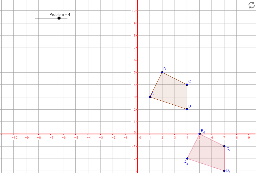
This example helps 8-10th grade students understand the concept of translation through geometric transformations on a coordinate grid. Using commands like Polygon, Vector, and Translate, students can observe how points and shapes change under translation. Suitable for beginners to learn the basics of geometric transformations.
GeoGebra Commands & Parameters
Polygon(A, B, C, D) → poly1, a, b, c, dVector(E, F) → uTranslate(A_1, u) → GTranslate(B_1, u) → HTranslate(C_1, u) → ITranslate(D_1, u) → JVector(E, K) → vTranslate(A_1, v) → LTranslate(B_1, v) → MTranslate(C_1, v) → NTranslate(D_1, v) → OVector(E, P) → wTranslate(A_1, w) → QTranslate(B_1, w) → RTranslate(C_1, w) → STranslate(D_1, w) → TTranslate(A, u) → A'_1Translate(B, u) → B'_1Translate(C, u) → C'_1Translate(D, u) → D'_1Polygon(A'_1, B'_1, C'_1, D'_1) → poly1', a', b', c', d'Translate(A_1, u) → UTranslate(B_1, u) → VTranslate(C_1, u) → WTranslate(D_1, u) → ZPolygon(U, V, W, Z) → poly2, u_1, v_1, w_1, zTranslate(A, v) → A'_2Translate(B, v) → B'_2Translate(C, v) → C'_2Translate(D, v) → D'_2Polygon(A'_2, B'_2, C'_2, D'_2) → poly1'_1, a'_1, b'_1, c'_1, d'_1Translate(A_1, v) → E_1Translate(B_1, v) → F_1Translate(C_1, v) → G_1Translate(D_1, v) → H_1Polygon(E_1, F_1, G_1, H_1) → poly3, e_1, f_1, g_1, h_1Translate(A, w) → A'_3Translate(B, w) → B'_3Translate(C, w) → C'_3Translate(D, w) → D'_3Polygon(A'_3, B'_3, C'_3, D'_3) → poly1'_2, a'_2, b'_2, c'_2, d'_2Translate(A_1, w) → I_1Translate(B_1, w) → J_1Translate(C_1, w) → K_1Translate(D_1, w) → L_1Polygon(I_1, J_1, K_1, L_1) → poly4, i_1, j_1, k_1, l_1Translate(A'_3, Vector[(0, 0)]) → A''Polygon(A_4, B_4, C_4, D_4) → poly1_2, a_2, b_2, c_2, d_2Polygon(A_3, B_3, C_3, D_3) → poly1_3, a_3, b_3, c_3, d_3Polygon(A_5, B_5, C_5, D_5) → poly1_4, a_4, b_4, c_4, d_4Polygon(A_6, B_6, C_6, D_6) → poly1_5, a_5, b_5, c_5, d_5