
Exploring the Properties of Kites
Loading the math board and drawing, please wait…
In collections
Kites and Trapezoids Exploration
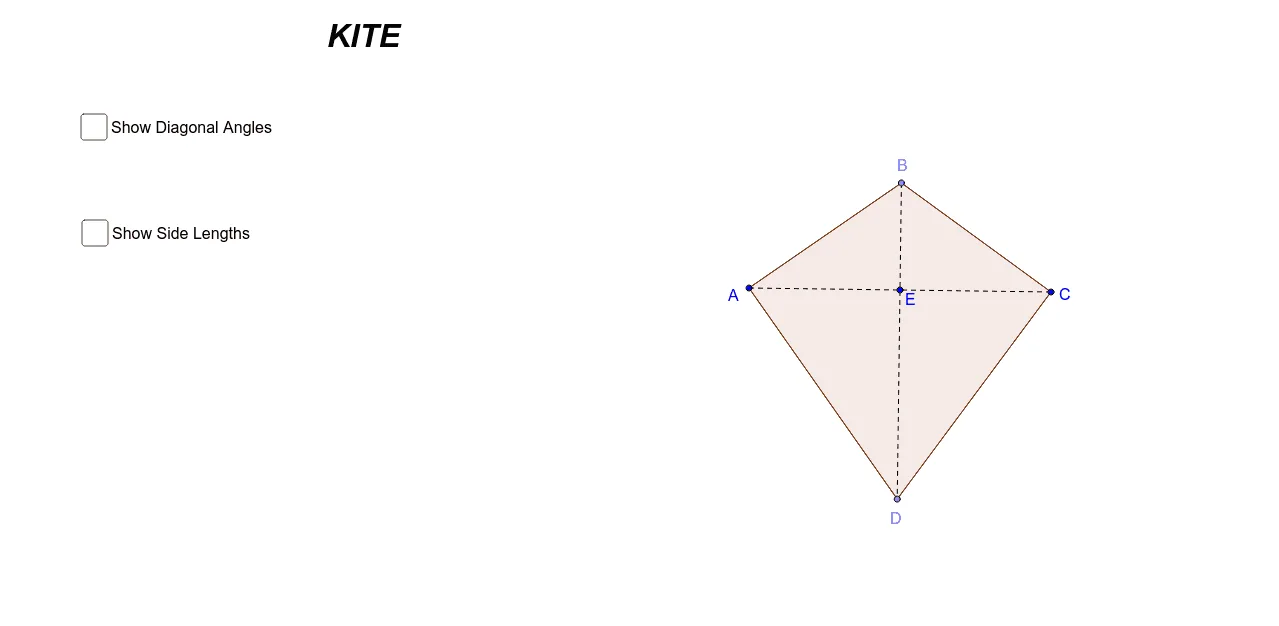
This example demonstrates the geometric properties of a kite, a special quadrilateral, focusing on the relationships between its sides, angles, and diagonals. Key math concepts include congruence, symmetry, and quadrilateral properties in geometry. Construction highlights: GeoGebra commands like Segment for drawing lines, LineBisector for perpendicular bisectors, Point and Intersect for defining points, Distance and Angle for measurements, and Polygon for shapes; objects include points A, B, C, D, distance variables like distanceAB, and angle variables like α, β, γ, δ. Suitable for middle or high school geometry lessons, ideal for interactive learning of kite characteristics.
GeoGebra Commands & Parameters
Segment(A, C) → aLineBisector(A, C) → bPoint(b) → BPoint(b) → DSegment(A, B) → cSegment(B, C) → dSegment(A, D) → eSegment(C, D) → fSegment(B, D) → gSegment(A, C) → hIntersect(g, h) → EDistance(A, B) → distanceABDistance(B, C) → distanceBCDistance(C, D) → distanceCDDistance(D, A) → distanceDADistance(A, C) → distanceACDistance(B, A) → distanceBADistance(A, E) → distanceAEDistance(C, E) → distanceCEDistance(B, E) → distanceBEDistance(D, E) → distanceDEDistance(B, D) → distanceBDAngle(D, A, B) → αAngle(A, B, C) → βAngle(B, C, D) → γAngle(C, D, A) → δAngle(E, A, B) → εAngle(A, B, E) → ζAngle(E, B, C) → ηAngle(B, C, E) → θAngle(E, C, D) → ιAngle(C, D, E) → κAngle(E, D, A) → λAngle(D, A, E) → μAngle(B, E, A) → νAngle(C, E, B) → ξAngle(D, E, C) → οAngle(A, E, D) → ρPolygon(A, B, C, D) → poly1, a_1, b_1, c_1, d_1
AI Drawing Prompt Reference
Draw a kite ABCD with points A, B, C, and D as vertices. First, draw line segment AC, then construct the perpendicular bisector of AC, which intersects AC at point B. Next, draw line segments BC, CD, and DA, and finally, draw quadrilateral ABCD. Measure the lengths of the sides and the angles.
The prompt above was compiled from the original drawing commands and is for reference only.