
Exploring Exponential Products in 3D Surfaces
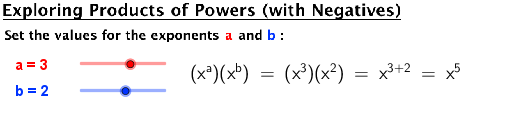
Loading the math board and drawing, please wait…
This GeoGebra example investigates the graphical behavior of exponentiation applied to products of variables, visualizing how exponent rules shape three-dimensional surfaces. It demonstrates core concepts such as the laws of exponents, product properties, implicit and parametric surface plotting, and symmetry transformations. Users can interactively adjust exponent values and observe real-time changes to surface topology, curvature, and symmetric properties. The construction leverages GeoGebra commands like expTop, expSubst, and expEval for expression handling; dir1Set, dir1a, dir1b for directional control; and text, titleHidden, and symmetry objects for annotation and dynamic adjustment. It also integrates derivative and logic commands to dynamically modify graph attributes. Ideal for high school function units, calculus introduction, or analytic geometry courses, it serves as a valuable tool for students and educators exploring exponential functions in multidimensional contexts.
GeoGebra Commands & Parameters
Numeric a(3.0)Numeric b(2.0)Numeric c(-1.0)Boolean d(false)Boolean e(false)
AI Drawing Prompt Reference
Draw a 3D surface that visualizes how exponentiation of a product of variables shapes the surface. Include three adjustable exponent parameters (initially 3, 2, -1) and two toggles controlling symmetry display and derivative‑related features. The surface should be renderable both implicitly and parametrically, updating in real time as parameters change to reveal curvature, topology, and symmetry variations for interactive exploration and educational demonstration.
The prompt above was compiled from the original drawing commands and is for reference only.