
Exploring Characteristics of Squares and Rectangles
Loading the math board and drawing, please wait…
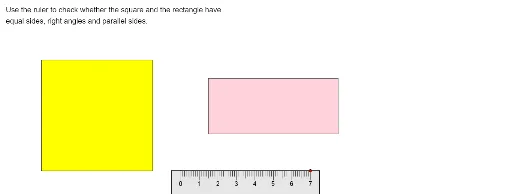
①This GeoGebra example dynamically demonstrates the key characteristics of squares and rectangles, including side lengths, right angles, and diagonal properties, while highlighting their similarities and differences. ②Core math concepts covered include polygon properties, parallel and perpendicular lines, angle measures, diagonal congruence and bisection, as well as related topics like linear regression, means, equilateral triangles, and ratios. ③Construction details: using GeoGebra commands such as Point, UnitOrthogonalVector, UnitVector, and Polygon, the construction involves multiple points (A_1, A_2, etc.), vectors (u, v), polygons (poly1, poly2, poly6), and auxiliary objects (ruler, text2, pic1). Vectors control the orientation of sides and angles, allowing interactive adjustment of the shapes. ④Suitable for upper elementary to middle school students learning plane geometry, and useful for classroom demonstrations or self-guided exploration to understand the properties and classification of special quadrilaterals.
GeoGebra Commands & Parameters
Point(Circle[A_1, ruler]) → A_6UnitOrthogonalVector(Segment[A_1, A_6]) → vUnitVector(Segment[A_1, A_6]) → uPolygon(A_1, A_2, A_3, A_4, A_5, A_6) → poly6, a_3, a_4, a_5, a_6, a_7, a_8Polygon((-4, -1), (2, -1), (2, 5), (-4, 5)) → poly1, a, b, c, dPolygon((5, 1), (12, 1), (12, 4), (5, 4)) → poly2, e, g, h, i