
Explore circumcenters, incenters, centroids and orthocenters
Loading the math board and drawing, please wait…
In collections
Median Triangle
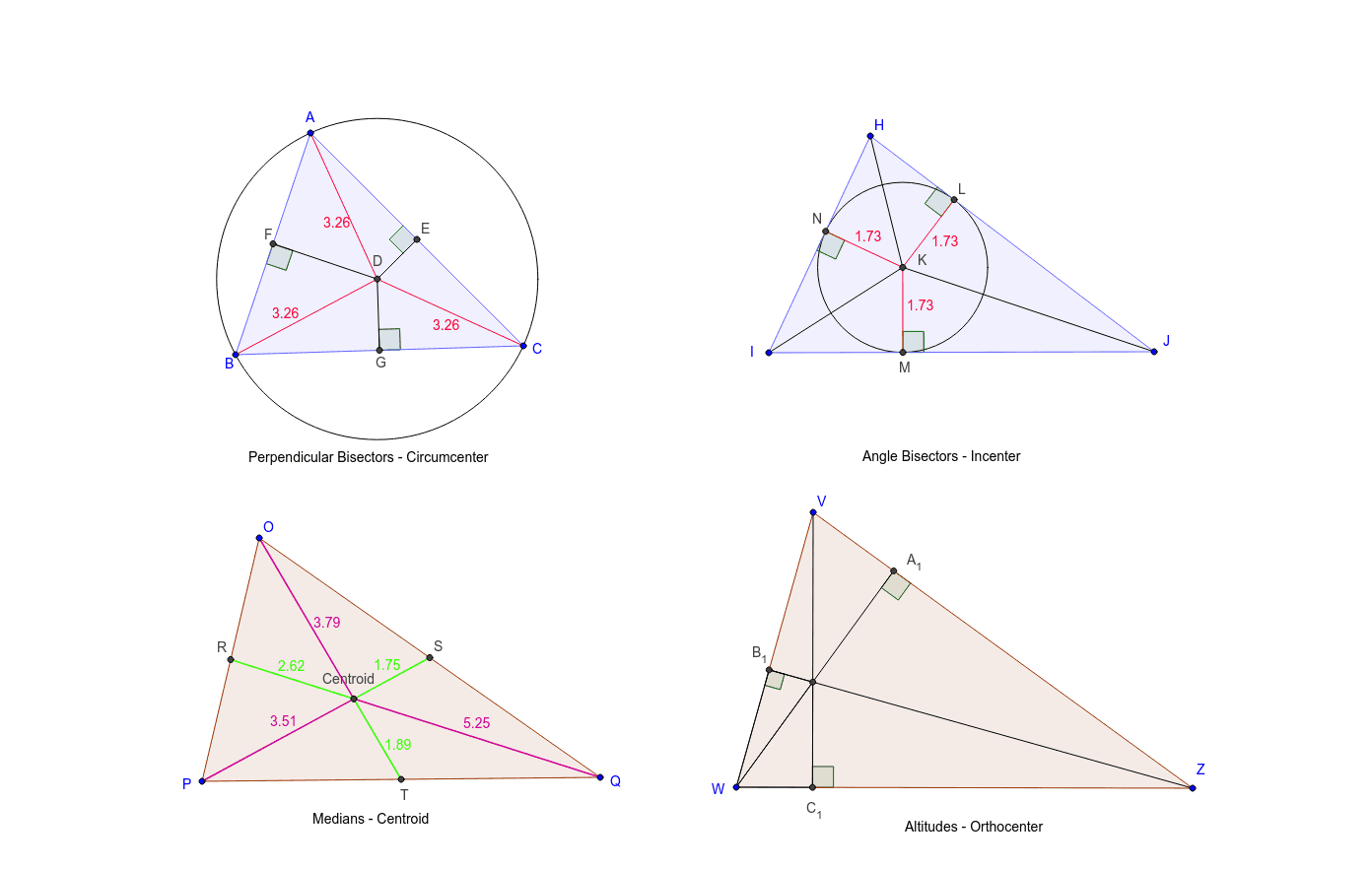
This example demonstrates the positions and properties of circumcenters, incenters, centroids, and orthocenters in a triangle. Key mathematical concepts include triangle centers, perpendicular bisectors, angle bisectors, midpoints, and distance calculations. The construction utilizes GeoGebra commands such as Polygon, LineBisector, Intersect, Segment, Circle, AngularBisector, OrthogonalLine, Midpoint, Angle, and Distance. It is suitable for high school and above students to visually understand triangle geometry and construction methods.
GeoGebra Commands & Parameters
Polygon(A, B, C) → poly1, c, a, bLineBisector(c) → dLineBisector(b) → eLineBisector(a) → fIntersect(d, e) → DIntersect(e, b) → EIntersect(d, c) → FIntersect(f, a) → GSegment(D, G) → gSegment(D, E) → hSegment(D, F) → iCircle(D, B) → kSegment(D, B) → jSegment(D, A) → lSegment(D, C) → mPolygon(H, I, J) → poly2, j_1, h_1, i_1AngularBisector(H, I, J) → nAngularBisector(J, H, I) → pAngularBisector(I, J, H) → qIntersect(n, q) → KOrthogonalLine(K, h_1) → rOrthogonalLine(K, i_1) → sOrthogonalLine(K, j_1) → tIntersect(s, i_1) → LIntersect(r, h_1) → MIntersect(t, j_1) → NSegment(K, N) → a_1Segment(K, L) → b_1Segment(K, M) → c_1Segment(K, I) → d_1Segment(K, J) → e_1Segment(K, H) → f_1Circle(K, M) → g_1Polygon(O, P, Q) → poly3, q_1, o, p_1Midpoint(q_1) → RMidpoint(p_1) → SMidpoint(o) → TSegment(Q, R) → k_1Segment(P, S) → l_1Intersect(l_1, k_1) → CentroidSegment(P, S) → m_1Segment(Q, R) → n_1Segment(O, T) → r_1Polygon(V, W, Z) → poly4, z, v, wOrthogonalLine(V, v) → s_1OrthogonalLine(Z, z) → t_1OrthogonalLine(W, w) → a_2Intersect(a_2, w) → A_1Intersect(t_1, z) → B_1Intersect(s_1, v) → C_1Segment(V, C_1) → b_2Segment(A_1, W) → c_2Segment(B_1, Z) → d_2Intersect(c_2, d_2) → D_1Segment(O, Centroid) → e_2Segment(Centroid, T) → f_2Segment(S, Centroid) → g_2Segment(Centroid, P) → h_2Segment(R, Centroid) → i_2Segment(Centroid, Q) → j_2Angle(Z, C_1, V) → αAngle(W, A_1, Z) → βAngle(Z, B_1, W) → γAngle(J, M, K) → δAngle(H, L, K) → εAngle(I, N, K) → ζAngle(C, G, D) → ηAngle(A, E, D) → θAngle(B, F, D) → ιAngle(W, B_1, D_1) → κDistance(l, j) → uDistance(m, c_1) → o_1Distance(a_1, b_1) → u_1Distance(h_2, g_2) → v_1Segment(B_1, W) → k_2Segment(W, C_1) → l_2Segment(B_1, D_1) → m_2Segment(W, D_1) → n_2Segment(C_1, D_1) → p_2
AI Drawing Prompt Reference
Draw a triangle ABC and find its circumcenter, incenter, centroid, and orthocenter. First, draw the three sides of the triangle, then draw the perpendicular bisectors of each side, which intersect at the circumcenter D, E, and F. Next, draw the circumcircle and connect the circumcenter to each vertex of the triangle. Then, draw the angle bisectors, which intersect at the incenter K. Draw perpendiculars from the incenter to each side, which intersect at points L, M, and N. Connect the incenter to these points to form a new triangle. Next, draw the midpoints of the sides, connect these midpoints to form the medians, which intersect at the centroid. Finally, draw perpendiculars from the centroid to each side, which intersect at point A1.
The prompt above was compiled from the original drawing commands and is for reference only.