
Existence of the Orthocenter in a Right Triangle
Loading the math board and drawing, please wait…
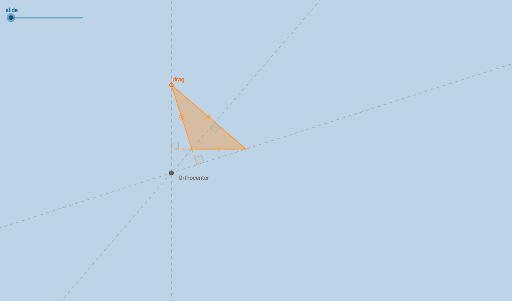
This example demonstrates the existence of the orthocenter in a right triangle. The orthocenter is the point where the three altitudes of a triangle intersect. By constructing triangle ABC and using commands like Dilate, Vector, Translate, Segment, Polygon, OrthogonalLine, Intersect, Line, Angle, Rotate, CircleArc, the existence of the orthocenter is visually demonstrated. Suitable for middle school and above students learning triangle geometry.
GeoGebra Commands & Parameters
Dilate(A, If[0 < t < 1, 1 - t, 0], C) → A_{1}Vector(A, C) → uTranslate(B, u) → B'Vector(B, C) → vTranslate(A, v) → A'Dilate(B, If[0 < t < 1, 1 - t, 0], B') → B_{1}Segment(A_{1}, B_{1}) → fDilate(B, If[1 < t < 2, 2 - t, 0], C) → B_{2}Dilate(A, If[1 < t < 2, 2 - t, 0], A') → A_{2}Segment(A_{2}, B_{2}) → gDilate(B, If[2 < t < 3, 3 - t, 0], A) → B_{3}Dilate(C, If[2 < t < 3, 3 - t, 0], A') → C_{3}Segment(C_{3}, B_{3}) → hVector(C, A) → wTranslate(B, w) → B'_1Dilate(C, If[3 < t < 4, 4 - t, 0], A) → C_{4}Dilate(B, If[3 < t < 4, 4 - t, 0], B'_1) → B_{4}Segment(C_{4}, B_{4}) → iDilate(A, If[4 < t < 5, 5 - t, 0], B'_1) → A_{5}Dilate(C, If[4 < t < 5, 5 - t, 0], B) → C_{5}Segment(C_{5}, A_{5}) → jDilate(A, If[5 < t ≤ 6, 6 - t, 0], B) → A_{6}Dilate(C, If[5 < t < 6, 6 - t, 0], B') → C_{6}Segment(A_{6}, C_{6}) → kPolygon(A, B, C) → poly1, c, a, bOrthogonalLine(C, c) → lOrthogonalLine(A, a) → mOrthogonalLine(B, b) → nIntersect(l, n) → DLine(B, A) → pIntersect(p, l) → ELine(B, C) → qLine(A, C) → rIntersect(r, n) → FIntersect(m, q) → GSegment(A, E) → sAngle(A, E, C) → αSegment(C, G) → eAngle(A, G, B) → βSegment(A, F) → f_1Angle(B, F, C) → γRotate(A', If[7 < t, (-((360° * t))), 0], D) → A''Angle(A'', D, A') → δDilate(D, If[6 < t < 7, 7 - t, 0], A'') → D'CircleArc(D, A'', A') → c_1Segment(D, D') → g_1
AI Drawing Prompt Reference
Draw a right triangle and demonstrate its orthocenter, the intersection point of the three altitudes. Construct the triangle first, then use vectors, translations, and dilations to create auxiliary line segments. Finally, find the intersection points of these segments to locate the orthocenter, highlighting it with a distinct color. Label the key angles and altitudes to clearly show the orthocenter's position and properties in the right triangle.
The prompt above was compiled from the original drawing commands and is for reference only.