
Estimating Volumes: Everyday Benchmarks and Random Practice
Loading the math board and drawing, please wait…
In collections
Wiederholung: Flächen- und Raummaße
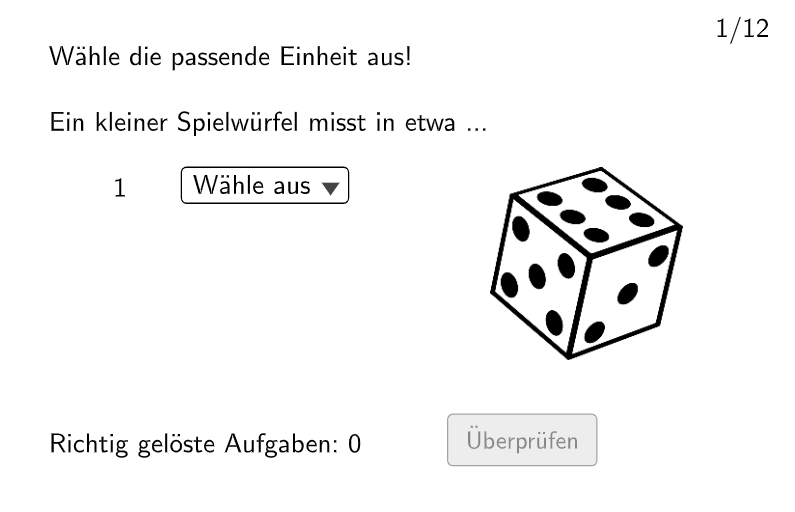
① This interactive GeoGebra example presents a series of random volume estimation tasks, showing images of various 3D shapes (e.g., cuboids, cylinders) and asking students to estimate their volume in chosen units. ② The core mathematical concept is volume estimation and unit awareness, linking abstract units (cubic centimeters, liters) to familiar everyday objects (milk cartons, water glasses) to develop a sense of magnitude. ③ Construction highlights: The applet uses the Shuffle and Element commands to randomly select questions, a dropdown menu for unit selection, text objects (txtQuestion) for prompts, a validation button (btnValidate) to check answers, and image objects (imgA, imgB, etc.) to display the shapes. It also tracks attemptCount and correctCount for progress, provides hints (txtHint) and a retry button (btnTryAgain). ④ This resource is designed for grades 5-6 students, suitable for classroom practice or homework, helping them connect volume concepts with real-life comparisons and improve estimation skills.
GeoGebra Commands & Parameters
Shuffle(1…12) → randomNumbers, {3, 1, 7, 6, 4, 10, 12, 11, 5, 9, 8, 2}Element(randomNumbers, Mod[questionCount, Length[randomNumbers]] + 1) → randomNumber
AI Drawing Prompt Reference
Draw a graph containing various 3D shapes, such as cuboids and cylinders, showing volume estimation tasks. The graph should include images of the shapes, prompt text, a unit selection dropdown menu, a validation button, a progress tracker, and hint information. The volume estimation tasks should be linked to everyday objects, like milk cartons and water glasses, to help students connect volume concepts with real-life comparisons and improve estimation skills.
The prompt above was compiled from the original drawing commands and is for reference only.