
Equivalent Fractions by Kaitlyn Mihovk
Loading the math board and drawing, please wait…
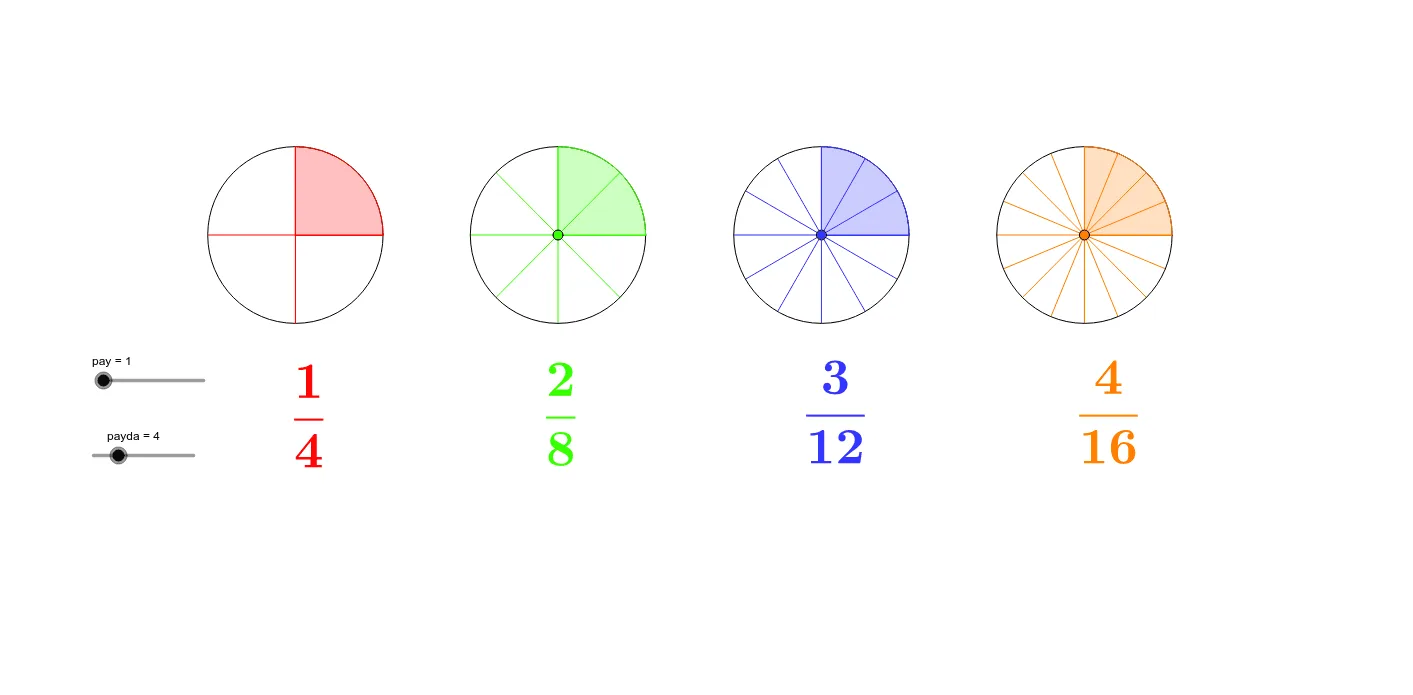
This example demonstrates the concept of equivalent fractions. It involves the basic properties of fractions, showing equivalent transformations through rotation and intersection operations. Commands used include Circle, Sequence, Point, Rotate, and Intersect. Suitable for high-grade elementary or junior high school students to learn about equivalent fraction transformations.
GeoGebra Commands & Parameters
Circle((0, 0), 1) → cSequence(Rotate[A, (i * 360 / payda)°], i, 1, payda) → liste1Point(xAxis) → CCircle(C, 1) → gPoint(xAxis) → DCircle(D, 1) → hPoint(xAxis) → ECircle(E, 1) → kPoint(g) → FPoint(h) → GPoint(k) → HRotate(A, (360 * pay / payda)°) → A'Rotate(F, (360 * pay / payda)°, C) → F'Rotate(G, (360 * pay / payda)°, D) → G'Rotate(H, (360 * pay / payda)°, E) → H'Intersect(xAxis, yAxis) → BCircleSector(B, A, A') → dCircleSector(C, F, F') → pCircleSector(D, G, G') → qCircleSector(E, H, H') → rSequence(Rotate[F, (i * 360 / (2 * payda))°, C], i, 1, 2 * payda) → liste4Sequence(Rotate[G, (i * 360 / (3 * payda))°, D], i, 1, 3 * payda) → liste5Sequence(Rotate[H, (i * 360 / (4 * payda))°, E], i, 1, 4 * payda) → liste6Sequence(Segment[(0, 0), Element[liste1, i]], i, 1, payda) → liste3Sequence(Segment[C, Element[liste4, i]], i, 1, 2 * payda) → liste2Sequence(Segment[D, Element[liste5, i]], i, 1, 3 * payda) → liste7Sequence(Segment[E, Element[liste6, i]], i, 1, 4 * payda) → liste8