
Dynamic Pythagoras Theorem Demonstration
Loading the math board and drawing, please wait…
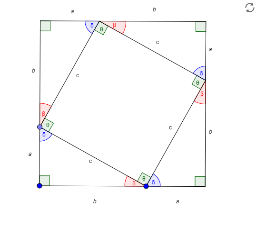
This example demonstrates the Pythagorean theorem through a dynamic geometric figure. It shows that the sum of the squares of the two legs of a right triangle is equal to the square of the hypotenuse. Key mathematical concepts include right triangles, the Pythagorean theorem, and angles. It uses commands such as Segment, OrthogonalLine, Point, Rotate, Intersect, Angle, Midpoint, Text, and Polygon in GeoGebra. Suitable for middle school and above students to learn geometry and proofs.
GeoGebra Commands & Parameters
Segment(A, B) → aOrthogonalLine(A, a) → bPoint(b) → CSegment(A, C) → cSegment(C, B) → dRotate(C, 90°, C) → C'Rotate(B, 90°, C) → B'Segment(C', B') → d'Rotate(C', 90°, B') → C''Rotate(B', 90°, B') → B''Segment(C'', B'') → d''Segment(C'', B) → eOrthogonalLine(B', b) → gIntersect(b, g) → DSegment(C, D) → fSegment(D, B') → hOrthogonalLine(C'', g) → iIntersect(g, i) → ESegment(B', E) → jSegment(E, C'') → kOrthogonalLine(B, i) → lSegment(E, C'') → mIntersect(i, l) → FSegment(C'', F) → nSegment(F, B) → pAngle(C, D, B') → αAngle(B', E, C'') → βAngle(B, F, C'') → γAngle(d', d) → δAngle(C, A, B) → εAngle(C, B, C'') → ζAngle(B'', C'', B) → ηAngle(d'', d) → θIntersect(d', d'') → HAngle(C, B, A) → κAngle(B, C'', F) → λAngle(f, d') → μAngle(A, C, B) → νAngle(D, B', C') → ξAngle(B'', C'', E) → οAngle(C'', B, F) → ρIntersect(d', d'') → KMidpoint(k) → MMidpoint(n) → NMidpoint(p) → OMidpoint(a) → PText(" a", M) → text9Text(" b", N) → text10Midpoint(c) → SMidpoint(f) → LLMidpoint(h) → UMidpoint(j) → VMidpoint(d'') → GAngle(G, H, V) → ιPoint(Circle[V, 0.3844228700967704]) → IPolygon(V, I, J) → poly1, j_1, v, i_1Point(Circle[U, 0.29763004734908566]) → LPolygon(U, L, R) → poly2, r, u, l_1Point(Circle[LL, 0.333181955679241]) → TPolygon(LL, T, Z) → poly3, z_1, w, tPoint(Circle[S, 0.44269092479036803]) → QText(text2, P) → text3Text(text1, O) → text4Text("a", L) → text7Text("a", Q) → text8Text("b", I) → text11Text("b", T) → text12Angle(C, H, G) → σ