
Dynamic Proof of SAS Triangle Congruence Theorem by Dan Dale
Loading the math board and drawing, please wait…
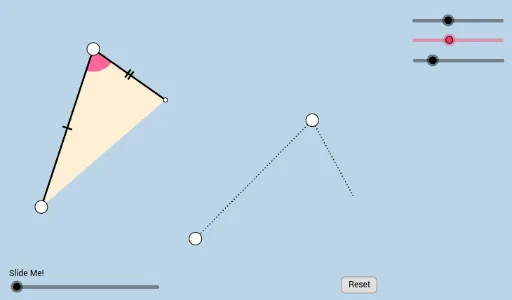
This example dynamically demonstrates the proof of the SAS Triangle Congruence Theorem. It involves core mathematical concepts such as triangle congruence criteria, angles, sides, and rotational transformations. The construction utilizes GeoGebra commands/objects like Circle, Point, Segment, Rotate, Angle, Ray, Intersect, Polygon, CircleSector, Mirror, Line, Dilate, Vector, and Translate. It is suitable for high school mathematics students to learn geometric proofs and for teachers to use in classroom demonstrations.
GeoGebra Commands & Parameters
Circle(A, a) → cPoint(c) → BSegment(A, B) → fCircle(A, b) → dRotate(B, α, A) → B'Angle(B, A, B') → βRay(A, B') → gIntersect(d, g, 1) → CSegment(B, C) → hSegment(A, C) → iMin(f, i) → eCircle(A, (0.25 * e)) → kIntersect(k, f) → D,Intersect(k, i) → E,Polygon(A, B, C) → poly1, c_1, a_1, b_1CircleSector(A, D, E) → pMirror(A, h) → A'Mirror(B, h) → B'_1Mirror(C, h) → C'Polygon(A', B'_1, C') → poly1', c', a', b'_1Mirror(p, h) → p'Mirror(A, h) → A'_1Mirror(B, h) → B'_2Segment(A'_1, B'_2) → f'Mirror(A, h) → A'_2Mirror(C, h) → C'_1Segment(A'_2, C'_1) → i'Line(C, B) → jPoint(j) → GPoint(j) → HRay(B, H) → lRay(C, G) → mCircle(F, a) → qPoint(q) → ISegment(F, I) → nRotate(I, α, F) → I'Angle(I, F, I') → γCircle(F, b) → rRay(F, I') → sIntersect(r, s, 1) → JSegment(I, J) → tSegment(F, J) → f_1Dilate(B, If[0 < u ≤ 1, 1 - u, 0], I) → B'_3Vector(B, B'_3) → vTranslate(A, v) → A'_3Translate(B, v) → B'_4Segment(A'_3, B'_4) → f'_1Line(B, n) → g_1Point(g_1) → KAngle(K, B, A) → δRotate(A'_3, If[1 < u ≤ 2, ((-(u - 1)) * δ), (-δ)], I) → LRotate(B'_4, If[1 < u ≤ 2, ((-(u - 1)) * δ), (-δ)], I) → MSegment(L, M) → h_1Dilate(A, If[2 < u ≤ 3, 3 - u, 0], F) → A'_4Vector(A, A'_4) → wTranslate(A, w) → A'_5Translate(C, w) → C'_2Segment(A'_5, C'_2) → i'_1Line(A, f_1) → i_1Point(i_1) → NAngle(N, A, C) → εRotate(A'_5, If[3 < u ≤ 4, ((-(u - 3)) * ε), (-ε)], F) → ORotate(C'_2, If[3 < u ≤ 4, ((-(u - 3)) * ε), (-ε)], F) → PSegment(O, P) → j_1Translate(p, w) → p'_1Rotate(p'_1, If[3 < u ≤ 4, ((-(u - 3)) * ε), (-ε)], F) → d_1Dilate(B, If[4 < u ≤ 5, 5 - u, 0], I) → B'_5Vector(B, B'_5) → u_1Translate(A, u_1) → A'_6Translate(B, u_1) → B'_6Translate(C, u_1) → C'_3Polygon(A'_6, B'_6, C'_3) → poly1'_1, c'_3, a'_6, b'_6Line(B, t) → k_1Point(k_1) → QAngle(Q, B, C) → ζRotate(A'_6, If[5 < u ≤ 6, ((-(u - 5)) * ε), (-ε)], I) → RRotate(B'_6, If[5 < u ≤ 6, ((-(u - 5)) * ε), (-ε)], I) → SRotate(C'_3, If[5 < u ≤ 6, ((-(u - 5)) * ε), (-ε)], I) → TPolygon(R, S, T) → poly2, t_1, r_1, s_1Segment(B, A) → l_1Segment(A, C) → m_1Segment(C, B) → n_1CircleSector(A, D, E) → e_1
AI Drawing Prompt Reference
Create a dynamic demonstration of the SAS Triangle Congruence Theorem. Start by drawing two circles, then construct triangle ABC using rotation and intersection points. Mirror triangle ABC and its related elements. Finally, use a series of rotations, reflections, and transformations to create another triangle A'B'C', ensuring both triangles are congruent.
The prompt above was compiled from the original drawing commands and is for reference only.