
Dynamic Geometric Construction and Properties of a Rhombus
Loading the math board and drawing, please wait…
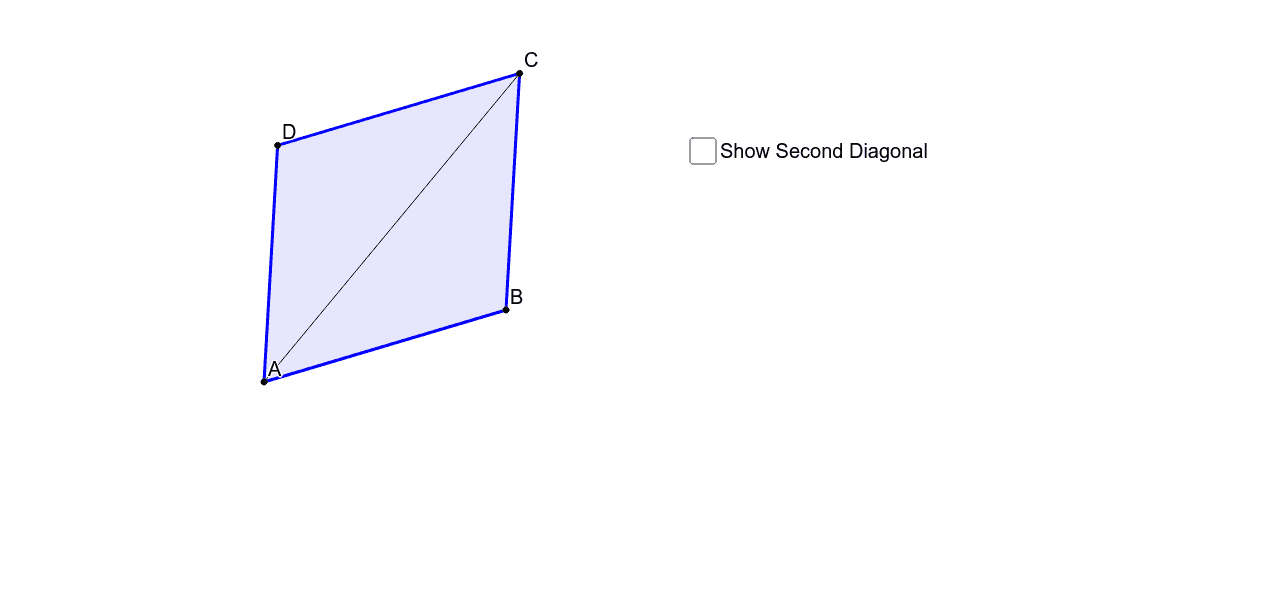
This GeoGebra example demonstrates the dynamic construction and geometric exploration of a rhombus. The core mathematical concepts covered include the classification of quadrilaterals, the definition of a rhombus (four equal sides), the perpendicular bisector properties of its diagonals, and geometric intersection theory. To construct the figure, the example utilizes key GeoGebra commands such as Line, Circle, Point, Intersect, Polygon, and Segment. By defining key vertices and intersection points (A, B, C, D, E, and auxiliary points like a_1, b_1), it builds the polygon `poly1` and visualizes the internal segment relationships. This resource is ideal for middle and high school geometry classrooms, inquiry-based learning activities, and teacher demonstrations on geometric constructions and properties.
GeoGebra Commands & Parameters
Line(A, B) → aCircle(A, B) → cPoint(c) → DLine(A, D) → bLine(B, b) → dLine(D, a) → eIntersect(d, e) → CPolygon(A, B, C, D) → poly1, a_1, b_1, d_1, c_1Segment(A, C) → fSegment(D, B) → gSegment(D, B) → iIntersect(f, i) → E