
Dividing Algebraic Terms
Loading the math board and drawing, please wait…
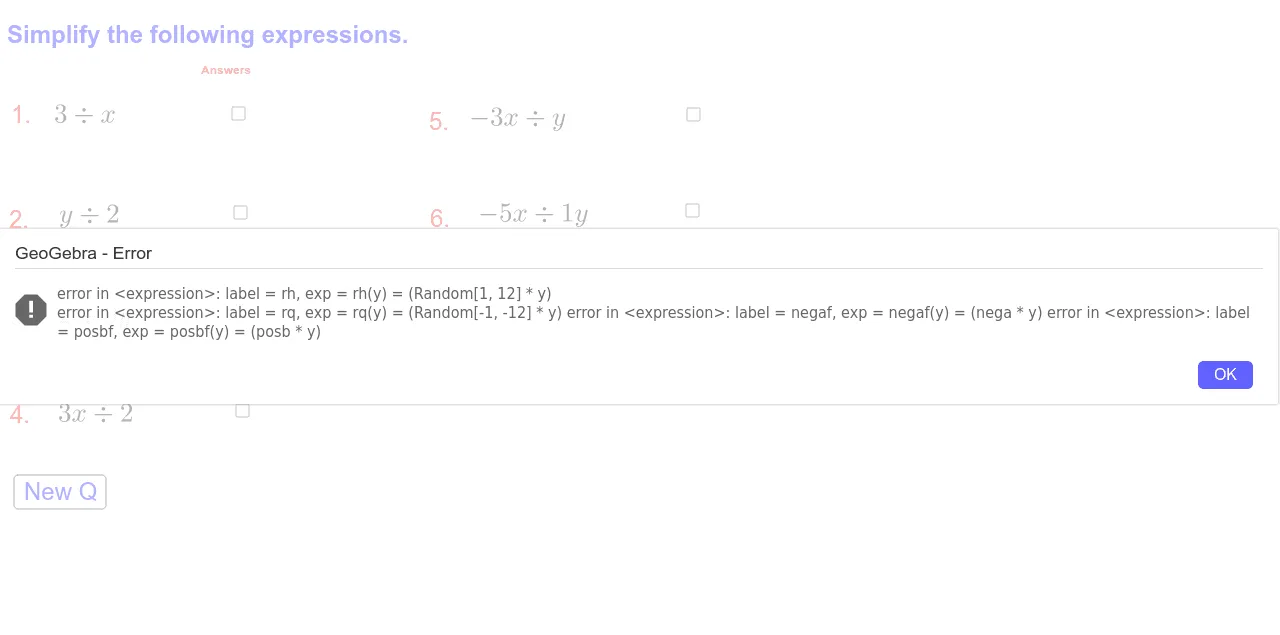
This example demonstrates how to perform division of algebraic terms using GeoGebra. The core mathematical concepts involved include algebraic terms, polynomial operations, and greatest common divisor (GCD). Key GeoGebra commands and objects used in the construction are Random, Simplify, GCD; and objects like text1, pne, negf, rh, rg, text2, text3, text4, text5, text6, button1, b, c, d, e, i, j, text32, text33, posa, posb, nega, posaf, negb, posc, posd, pose, posf, negc, negd, nege, rp, f, rq, ro, rrq, negaf, posbf, a, sf. This is suitable for high school mathematics education, helping students understand and master the methods and techniques of polynomial division.
GeoGebra Commands & Parameters
Random(-12, 12) → pneRandom(-1, -12) → negfRandom(1, 12) → posaRandom(1, 12) → posbRandom(-1, -12) → negaRandom(-1, -12) → negbRandom(1, 12) → poscRandom(1, 12) → posdRandom(1, 12) → poseRandom(1, 12) → posfRandom(-1, -12) → negcRandom(-1, -12) → negdRandom(-1, -12) → negeSimplify(((nega * x) * y)) → sfRandom(-6, 6) → pnaRandom(-6, 6) → pnbRandom(-6, 6) → pncSimplify((((((pna * x) * pnb) * y) * pnc) * z)) → sgSimplify(((posd * pose) * y)) → gSimplify((((pne * x) * negf) * y)) → hRandom(-1, -12) → negf_1Random(-12, 24) → pne_1Random(-12, 12) → pndSimplify((((pne_1 * x) * pnd) * y)) → oSimplify((posa / posb * x / y)) → simpaSimplify(posa / x) → pGCD(posa, posb) → qGCD(pose, posd) → rGCD(pne_1, pnd) → sGCD(pne_1, pnd) → tSimplify(((pne16 * x)) / ((pnd6 * y))) → uSimplify(((pne16 * x)) / pnd6) → f_1Simplify(((pna * x / pnb) * y)) → v
AI Drawing Prompt Reference
Create an educational diagram for algebraic term division, featuring several randomly generated monomial division examples in the center, each with numerator and denominator algebraic terms (involving x, y, z products) and simplified results labeled. Surrounding text boxes show original expressions, reduction steps, and final answers, with positive and negative coefficients color-coded. A button at the bottom regenerates random problems. The layout is clear for classroom demonstration, emphasizing simplification and greatest common divisor usage.
The prompt above was compiled from the original drawing commands and is for reference only.