
Directional Derivatives and Gradient Demo
Loading the math board and drawing, please wait…
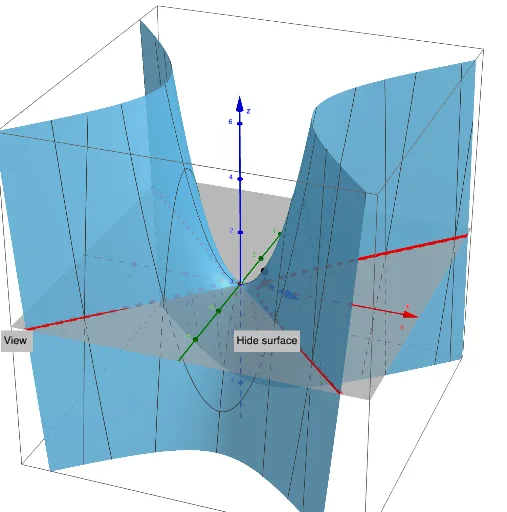
This example visually demonstrates the concept of directional derivatives and gradients through dynamic geometry. It illustrates how the gradient vector indicates the direction of steepest ascent and its magnitude corresponds to the rate of change. Key mathematical concepts include directional derivatives, gradient vectors, vector fields, and function graphs. Constructed using commands like Circle, Point, Vector, Function, Plane, Rotate, and Intersect, it provides an interactive way for high school and university students to explore multivariable calculus and differential geometry.
GeoGebra Commands & Parameters
Circle(P, 1) → tPoint(t) → BDerivative(f(x, y), x) → fxDerivative(f(x, y), y) → fyVector(P, P + (fx(x(P), y(P)), fy(x(P), y(P)))) → gradImplicitCurve(f(x, y) - f(x(P), y(P))) → cImplicitCurve(f(x, y)) → dImplicitCurve(f(x, y) - 1) → gImplicitCurve(f(x, y) - 2) → hImplicitCurve(f(x, y) - 3) → iImplicitCurve(f(x, y) - 4) → jImplicitCurve(f(x, y) - 5) → kImplicitCurve(f(x, y) + 1) → lImplicitCurve(f(x, y) + 2) → mImplicitCurve(f(x, y) + 3) → nImplicitCurve(f(x, y) + 4) → oImplicitCurve(f(x, y) + 5) → pPlane(P, P', P + (fx(x(P), y(P)), fy(x(P), y(P)))) → rCurveCartesian(x(P) + (fx(x(P), y(P)) * w), y(P) + (fy(x(P), y(P)) * w), w, -100, 100) → qCurveCartesian(x(P') + (fx(x(P), y(P')) * Q), y(P') + (fy(x(P), y(P)) * Q), z(P') + ((fx(x(P), y(P))^(2) + fy(x(P), y(P))^(2)) * Q), Q, -100, 100) → eTextfield(f) → InputBox1Textfield(Px) → InputBox2Textfield(Py) → InputBox3Length(grad) → normgradSegment(P'', P') → sFunction(f(x(P'), y(P')) + (fx(x(P'), y(P')) * (x - x(P'))) + (fy(x(P'), y(P')) * (y - y(P'))), x(P) - 1, x(P) + 1, y(P) - 1, y(P) + 1) → bRotate(B, θ, P) → AVector(P, A) → uOrthogonalLine(P, u, xOyPlane) → f_1OrthogonalPlane(P'', f_1) → vIntersectPath(v, f) → wIntersectPath(v, b) → a_1Angle(B, P, A) → βTextfield(θ) → InputBox4Point(zAxis) → CIntersect(zAxis, xAxis) → DVector(C, D) → u_1Point(yAxis) → EVector(E, D) → v_1Point(xAxis) → FVector(F, D) → w_1Element(list1, faces) → Selectedvector