
Partial Derivatives and the Tangent Plane
Loading the math board and drawing, please wait…
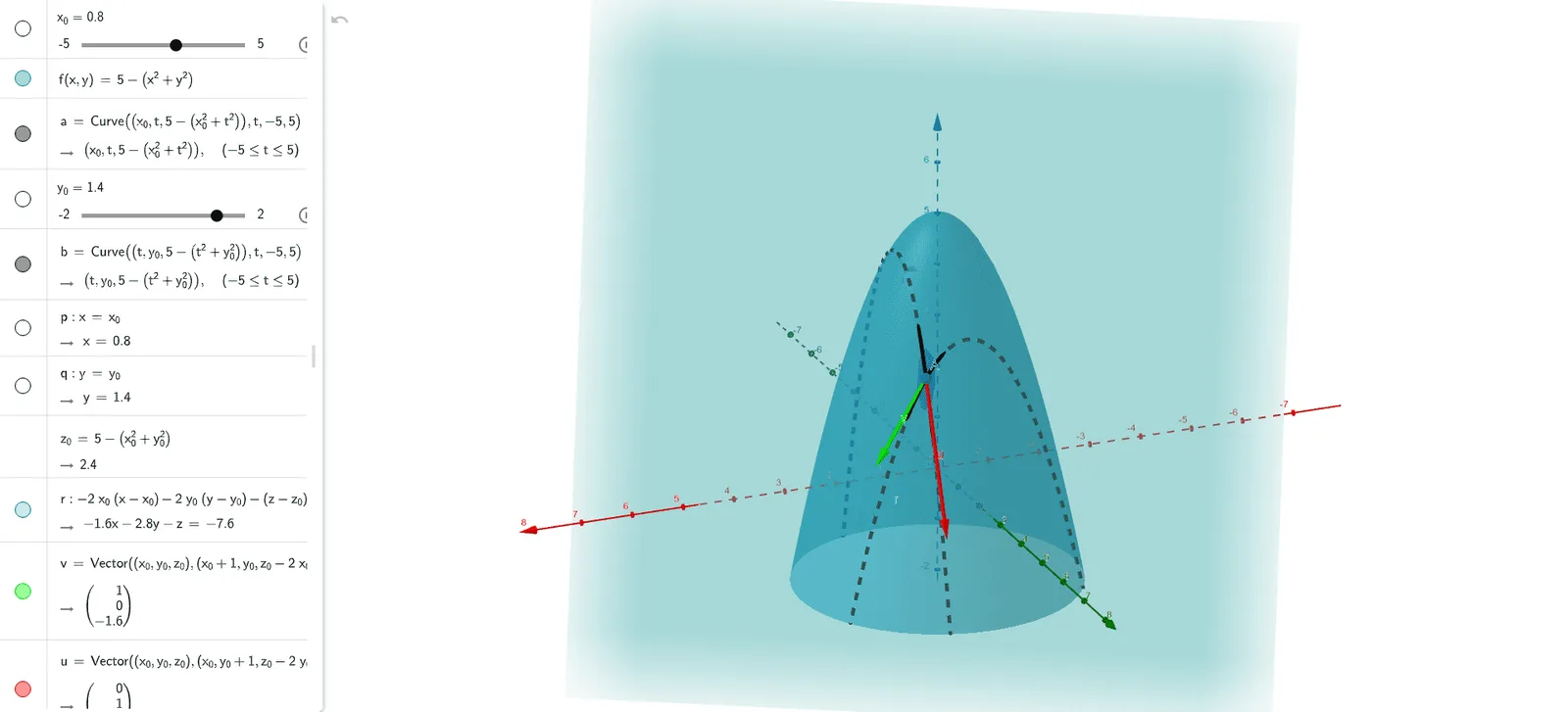
This example demonstrates the geometric meaning of partial derivatives and tangent planes. It visualizes the partial derivatives of a function at a point and the formation of the tangent plane. Key math concepts include partial derivatives, tangent planes, vectors, points, and curves. Construction highlights the use of GeoGebra commands like CurveCartesian, Vector, and Point to build the function graph, vectors, points, and tangent planes. Suitable for university-level mathematics and calculus instruction.
GeoGebra Commands & Parameters
CurveCartesian((x_{0}, t, 5 - (x_{0}^(2) + t^(2))), t, -5, 5) → aCurveCartesian((t, y_{0}, 5 - (t^(2) + y_{0}^(2))), t, -5, 5) → bVector((x_{0}, y_{0}, z_{0}), (x_{0} + 1, y_{0}, z_{0} - (2 * x_{0}))) → vVector((x_{0}, y_{0}, z_{0}), (x_{0}, y_{0} + 1, z_{0} - (2 * y_{0}))) → uPoint({x_{0}, y_{0}, z_{0}}) → A
AI Drawing Prompt Reference
Visualize a function in 3D space, highlighting its partial derivatives and tangent plane at a specific point. Start by plotting the function's graph, then draw vectors representing the partial derivatives at the point and mark the point itself. Next, construct a tangent plane using these vectors and the point, ensuring it touches the function graph at the specified point to clearly illustrate the geometric relationship between partial derivatives and the tangent plane.
The prompt above was compiled from the original drawing commands and is for reference only.