
Dilations Exploration by Lance Bledsoe
Loading the math board and drawing, please wait…
In collections
Dilations
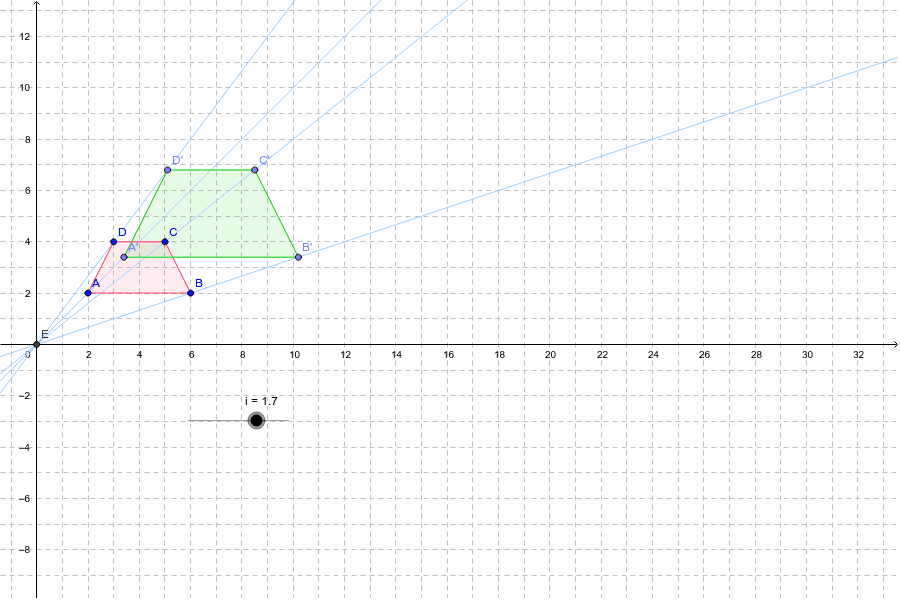
① This example illustrates how shapes such as polygons and spheres are transformed under a dilation, highlighting the relationship between original and scaled figures. ② Core mathematical concepts include dilation (scaling), similarity, perimeter scaling, exponentiation, and the three‑dimensional effects of dilation on spheres. ③ Construction highlights: GeoGebra commands Polygon, Intersect, and Line are employed to build the original polygon (poly1) and its dilated version (poly2); objects A, B, C, D, a, b, c, d, etc., represent vertices, while A′, B′, C′, D′ denote the transformed points. The intersection of lines and polygons is calculated to verify similarity. ④ Aimed at middle‑school to high‑school students (grades 7‑12) studying geometry transformations, it also serves as an interactive visual aid for teachers and classroom demonstrations on scaling and similarity.
GeoGebra Commands & Parameters
Polygon(A, D, C, B) → poly1, a, d, c, bIntersect(xAxis, yAxis) → ELine(E, D) → eLine(E, A) → fLine(E, C) → gLine(E, B) → hPolygon(A', D', C', B') → poly2, a', d', c', b'
AI Drawing Prompt Reference
Draw a figure consisting of an original shape and its scaled version. The original is a quadrilateral, and the scaled version is a similar quadrilateral. Connect them with a line that intersects the axes. Ensure the figure is clear to show the scaling and similarity relationship.
The prompt above was compiled from the original drawing commands and is for reference only.