
Dilation Angle Properties
Loading the math board and drawing, please wait…
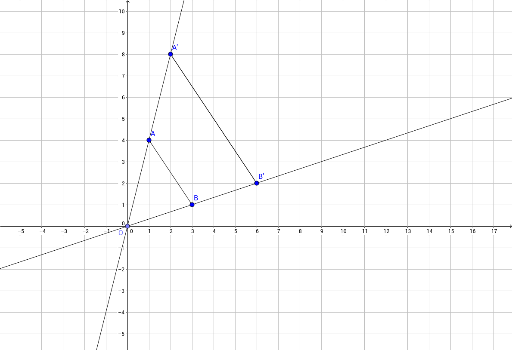
This GeoGebra example dynamically demonstrates that dilation (homothety) preserves angle measures, illustrating the invariant angle properties under a similarity transformation. It visually explores the relationships among the dilation center, corresponding points, and parallel lines. Core mathematical concepts include dilation, similarity, corresponding angles, parallel line properties, and parallelogram formation. Construction highlights: using Segment, Point, and Line commands to create original segment AB and its dilated image A'B', with point O as the dilation center; lines g and h connect corresponding points, while auxiliary segments i and j form a parallelogram to verify angle preservation. Suitable for upper middle school or high school geometry classes, this example helps students grasp the angle-preserving nature of dilations and serves as an interactive introduction to transformation geometry and similarity.
GeoGebra Commands & Parameters
Segment(A, B) → fSegment(A', B') → gSegment(A', B') → hPoint(yAxis) → OLine(O, A') → iLine(O, B') → j
AI Drawing Prompt Reference
Draw a diagram to demonstrate the invariance of angle measures under similarity transformations. Include an original segment and its dilated image, a dilation center, two lines connecting corresponding points, and a parallelogram formed by auxiliary segments to verify angle preservation. Start by drawing the original segment and its dilated image, then determine the dilation center, connect corresponding points with lines, and finally form a parallelogram with auxiliary segments.
The prompt above was compiled from the original drawing commands and is for reference only.