
Diagonals of Polygons
Loading the math board and drawing, please wait…
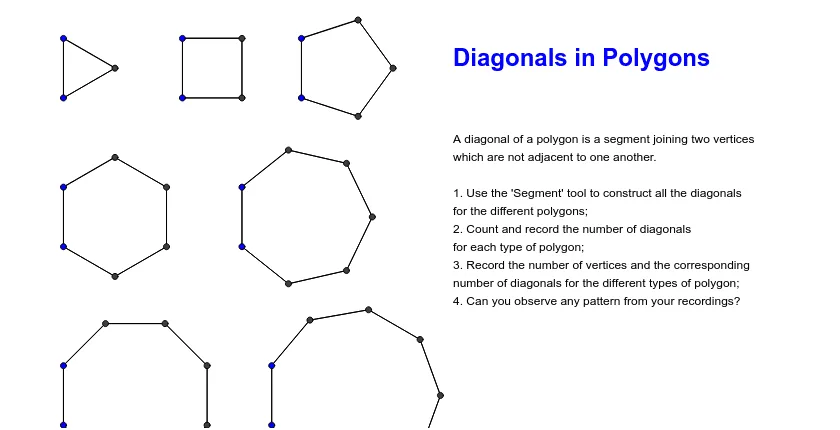
This example demonstrates the creation of diagonals in polygons and helps students discover patterns in the number of diagonals. Key mathematical concepts include properties of polygons and combinatorics. The construction uses the Polygon command and related point objects. Suitable for middle school and above students learning geometric construction and sequence patterns.
GeoGebra Commands & Parameters
Polygon(A, B, 3) → poly1, c, a, b, CPolygon(D, E, 4) → poly2, d, e, f, g, F, GPolygon(H, I, 5) → poly3, h, i, j, k, l, J, K, LPolygon(M, N, 6) → poly4, m, R, n, p, q, r, s, O, P, QPolygon(S, T, 7) → poly5, s_1, W, Z, A_1, t, a_1, b_1, c_1, d_1, e_1, U, VPolygon(B_1, C_1, 8) → poly6, b_2, E_1, F_1, G_1, H_1, I_1, c_2, f_1, g_1, h_1, i_1, j_1, k_1, D_1Polygon(J_1, K_1, 9) → poly7, j_2, L_1, M_1, N_1, O_1, P_1, Q_1, R_1, k_2, l_1, m_1, n_1, p_1, q_1, r_1, t_1
AI Drawing Prompt Reference
Draw a series of polygons, starting from a triangle and increasing the number of sides by one for each subsequent polygon. First, draw a triangle, then a quadrilateral, followed by a pentagon, and so on until a nonagon. Each polygon's vertices are labeled sequentially with letters like A, B, C, and so on. The polygons are connected by sharing vertices.
The prompt above was compiled from the original drawing commands and is for reference only.