
Demonstration of the Sum of Angles in a Hyperbolic Triangle
Loading the math board and drawing, please wait…
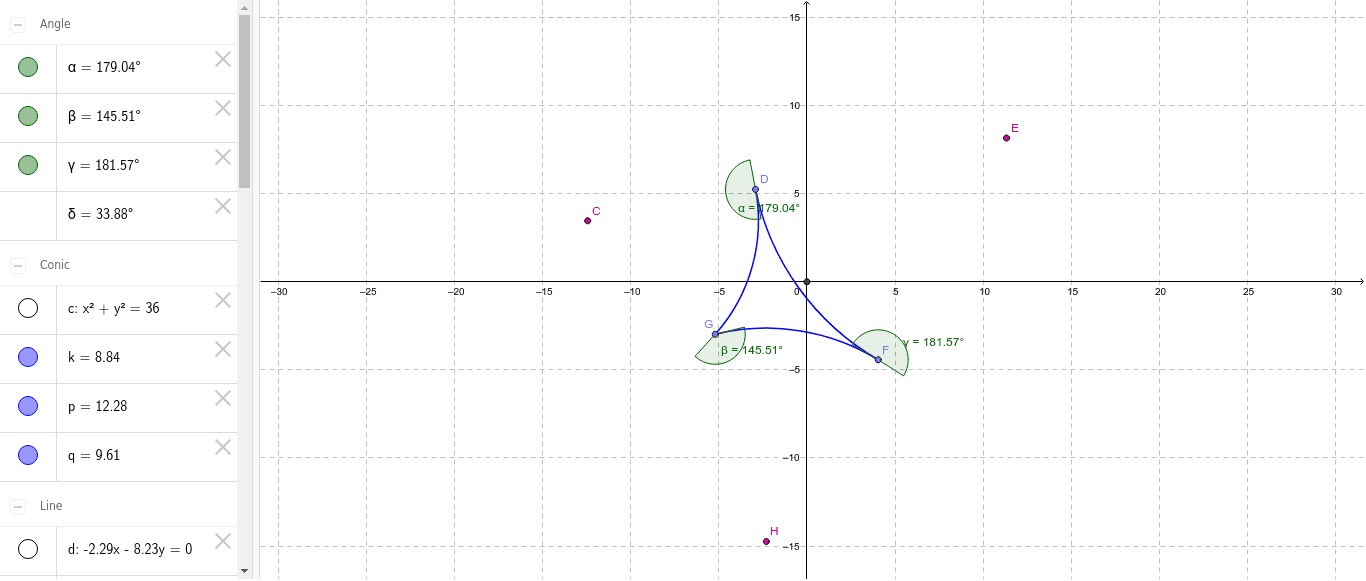
This example uses GeoGebra to demonstrate the sum of angles in a hyperbolic triangle. The key mathematical concepts involved are the angle sum theorem in hyperbolic geometry. By constructing a hyperbolic triangle, measuring its angles, and observing the properties, the nature of the angle sum in hyperbolic triangles is verified. Commands used include Intersect, Point, Segment, Polygon, Circle, LineBisector, CircleArc, Tangent, Angle, etc. Suitable for high school and above students or teachers for teaching purposes.
GeoGebra Commands & Parameters
Intersect(xAxis, yAxis) → APoint(Circle[A, 6]) → DSegment(A, D) → aPoint(Circle[A, 6]) → FSegment(A, F) → bPoint(Circle[A, 6]) → GSegment(A, G) → ePolygon(D, F, G) → poly1, g, d_1, fPoint(xAxis) → BCircle(A, B) → cLineBisector(f) → dLineBisector(g) → hLineBisector(d_1) → iPoint(d) → CCircleArc(C, G, D) → kPoint(h) → ECircleArc(E, D, F) → pPoint(i) → HCircleArc(H, F, G) → qTangent(D, k) → j,Tangent(D, p) → l,Tangent(G, k) → m,Tangent(G, q) → n,Tangent(F, q) → r,Tangent(F, p) → s,Angle(l, j) → αAngle(m, n) → βAngle(r, s) → γ