
Defining Multi-Colored Regions with Inequalities
Loading the math board and drawing, please wait…
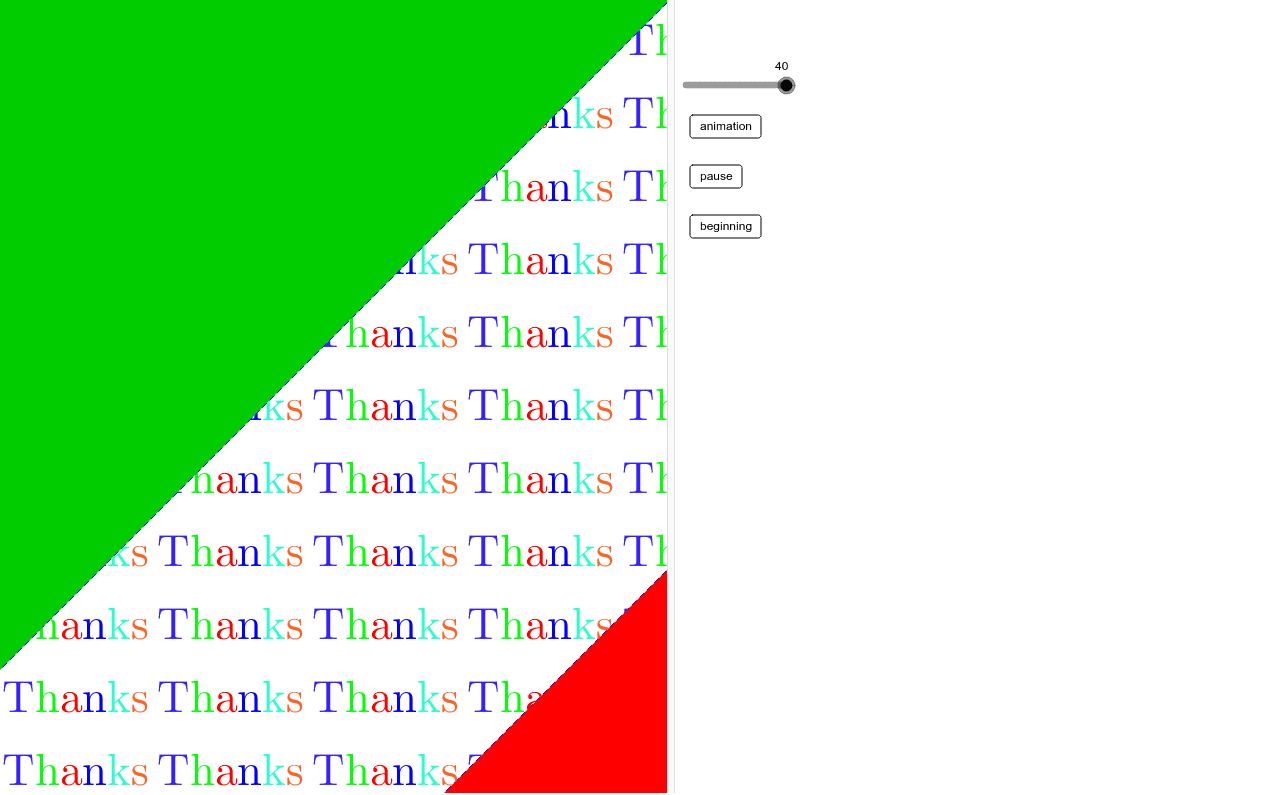
This example demonstrates how to define multi-colored regions using inequalities. It involves core math concepts like inequalities, region partitioning, and coordinate geometry. The construction utilizes GeoGebra commands/objects such as a, b, c, d, f, e, g, h, i, j, k, l, m, n, o, p, z, q, r, s, t, u, b_1, c_1, d_1, g_1, v, pulsante1, pulsante2, pulsante3, a_1, f_1, h_1, i_1, l_1, m_1, p_1, q_1, j_1, k_1. Suitable for high school mathematics education to understand the relationship between inequalities and graphical regions.
GeoGebra Commands & Parameters
a(x, y) = (x > 0) ∧ (y > 0)b(x, y) = (x < 0) ∧ (y > 0)c(x, y) = (x < 0) ∧ (y < 0)d(x, y) = (x > 0) ∧ (y < 0)f(x, y) = x - y > 0e(x, y) = x + y > 0g(x, y) = x - y < 0h(x, y) = x + y < 0a(x, y) ∧ f(x, y)b(x, y) ∧ h(x, y)a(x, y) ∧ g(x, y)e(x, y) ∧ b(x, y)c(x, y) ∧ g(x, y)c(x, y) ∧ f(x, y)d(x, y) ∧ h(x, y)d(x, y) ∧ e(x, y)Numeric z(40.0)q: x > 3r: x < -3s: y > 3t: y < -3u(x, y) = (-3 < x) ∧ (x < 3) ∧ (-3 < y) ∧ (y < 3)b_1(x, y) = 2 * x + 5 + y > 0c_1(x, y) = 3 * x - 5 - y < 0d_1(x, y) = 1 / 2 * x + 5 - y > 0g_1(x, y) = (2 * x + 5 + y > 0) ∧ (3 * x - 5 - y < 0) ∧ (1 / 2 * x + 5 - y > 0)a(x, y) ∧ b(x, y) ∧ c(x, y) ∧ d(x, y)a_1: -4 < x < -2f_1: -8 < x < -6h_1: 2 < y < 4i_1: 6 < y < 8l_1(x, y) = (-8 < x) ∧ (x < -6) ∧ (6 < y) ∧ (y < 8)m_1(x, y) = (-4 < x) ∧ (x < -2) ∧ (6 < y) ∧ (y < 8)p_1(x, y) = (-8 < x) ∧ (x < -6) ∧ (2 < y) ∧ (y < 4)q_1(x, y) = (-4 < x) ∧ (x < -2) ∧ (2 < y) ∧ (y < 4)j_1: -2 < y < 0k_1: -6 < y < -4t_1(x, y) = (-8 < x) ∧ (x < -6) ∧ (-2 < y) ∧ (y < 0)w: 0 < x < 2e_1: 4 < x < 6n_1(x, y) = (6 < y) ∧ (y < 8) ∧ (0 < x) ∧ (x < 2)o_1(x, y) = (6 < y) ∧ (y < 8) ∧ (4 < x) ∧ (x < 6)r_1(x, y) = (2 < y) ∧ (y < 4) ∧ (0 < x) ∧ (x < 2)s_1(x, y) = (2 < y) ∧ (y < 4) ∧ (4 < x) ∧ (x < 6)u_1(x, y) = (-4 < x) ∧ (x < -2) ∧ (-2 < y) ∧ (y < 0)v_1(x, y) = (-2 < y) ∧ (y < 0) ∧ (0 < x) ∧ (x < 2)w_1(x, y) = (-2 < y) ∧ (y < 0) ∧ (4 < x) ∧ (x < 6)z_1(x, y) = (-8 < x) ∧ (x < -6) ∧ (-6 < y) ∧ (y < -4)a_2(x, y) = (-4 < x) ∧ (x < -2) ∧ (-6 < y) ∧ (y < -4)b_2(x, y) = (-6 < y) ∧ (y < -4) ∧ (0 < x) ∧ (x < 2)c_2(x, y) = (-6 < y) ∧ (y < -4) ∧ (4 < x) ∧ (x < 6)Point A(1.7805908446546472, 1.2820737971730134)Point B(-3.219409155345355, 1.2820737971730134)Point C(-3.219409155345355, 5.2820737971730125)d_2(x, y) = x + 5 - y < 0e_2(x, y) = x - 5 - y > 0f_2(x, y) = (x + 5 - y > 0) ∧ (x - 5 - y < 0)